São Paulo is the technical capital of Brazilian zouk. If Rio is where the dance was born and where musicality runs deepest, São Paulo is where the teaching infrastructure that defines the modern international scene was built. Kadu Pires, Gilson Damasco, and a generation of Paulista teachers through the 1990s and 2000s shaped the workshop-and-congress model that now dominates zouk worldwide. Today, São Paulo is where a serious student goes to build technique, clean up frames, and absorb the pattern vocabulary that forms the backbone of modern zouk. This guide covers the reality of dancing zouk in São Paulo — the schools that anchor the scene, how SP differs from Rio, the congress calendar, and how to navigate a dance trip in South America’s largest city.
Table of Contents
- Why São Paulo Matters in Zouk
- The School System and Kadu Pires Lineage
- Neighborhoods and Where Zouk Actually Happens
- São Paulo vs Rio: Complementary Scenes
- Understanding Paulista Zouk Style
- The Weekly Practica and Social Circuit
- Festivals and Congresses
- Taking Classes in São Paulo
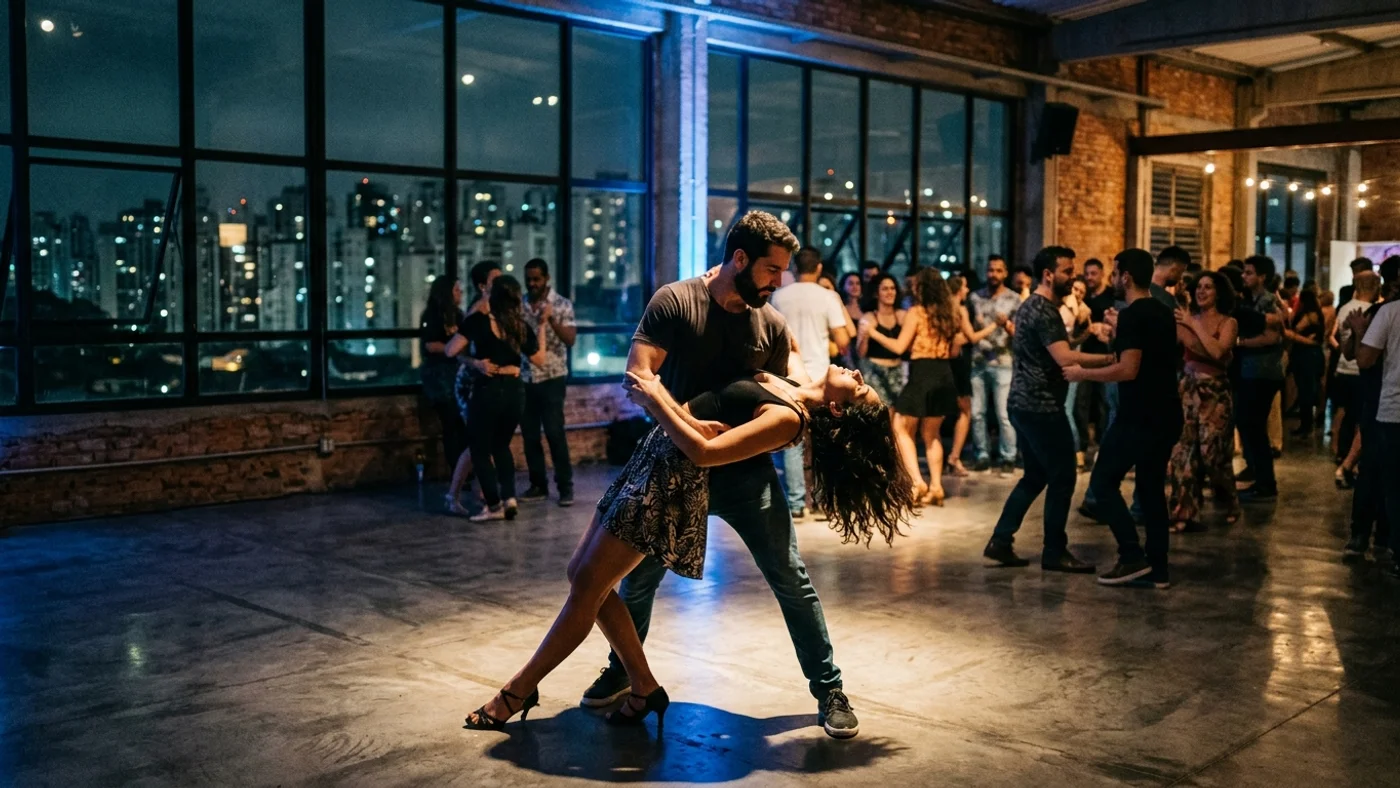
- What to Expect at a São Paulo Zouk Social
- Safety, Transport, and Logistics
- Combining São Paulo with Other Trips
- Find Events
- FAQ
Why São Paulo Matters in Zouk
Brazilian zouk emerged out of Rio’s dance scene in the 1990s, but its export to the world happened largely through São Paulo. Several dynamics drove that: São Paulo had a larger economy than Rio and more structured dance-school infrastructure, its teachers had more opportunities to travel internationally, and the city’s workshop-and-congress culture was more aligned with how Latin dance globalized through the 2000s and 2010s.
By the late 2000s, São Paulo-trained teachers — Kadu Pires, Gilson Damasco, Rodrigo Delano, and others — were leading classes in Europe, North America, and Asia. Many of today’s international zouk instructors either trained directly with SP teachers or are second-generation students of SP teachers. The “standard” zouk vocabulary that you learn at a Barcelona festival or a Tokyo workshop is substantially a product of this São Paulo export.
That matters for a visitor. The Paulista scene is the most aligned of any Brazilian zouk scene with what international students already know. If you have been dancing zouk for two years in Madrid or Warsaw, arriving in São Paulo will feel relatively familiar — the patterns, the class structure, the congress format all map onto what you have been training. Rio will feel more alien; São Paulo will feel like home base with better teachers.
The second thing São Paulo has going for it: sheer size. With over 12 million people in the city proper and over 22 million in the metro area, São Paulo supports a dance scene denser than any other Brazilian city. Multiple schools run parallel programs. The congress calendar fills with multiple events per year. The number of practicing instructors at advanced levels is arguably higher than anywhere outside Los Angeles or Berlin. For a dancer who wants pure teaching volume, SP delivers.
Our best zouk cities in South America guide places São Paulo and Rio together at the top of the continental list, and our best zouk festivals 2026 guide covers the global congress calendar including SP events.
The School System and Kadu Pires Lineage
São Paulo’s zouk scene is organized around dance schools rather than around social venues. The key schools — and the teachers who run them — are the structural backbone of the city’s dance life.
Kadu Pires and the Paulista Teaching Tradition
Kadu Pires is one of the most influential Brazilian zouk teachers of the past two decades. His studio has produced a generation of instructors and performers, and his teaching methodology — structured progression, clean technique, emphasis on body mechanics and musicality at intermediate-plus levels — has shaped how zouk is taught globally. Many of the international teachers you see at Barcelona, Prague, or Bangkok congresses trained directly with Kadu or with his senior students.
Visiting São Paulo without at least one class in the Kadu Pires lineage is a missed opportunity for a serious zouk student. His studio runs regular group classes, private lessons, and occasional workshops. If you can arrange even 2 to 3 hours of private instruction during your trip, it is likely the most efficient skill-build you will do anywhere in the zouk world.
Other Major Schools and Lineages
Gilson Damasco, Rodrigo Delano, Renata Peçanha (historically associated with Rio but with strong SP ties), and other veteran teachers run schools or teach through school networks across São Paulo. Newer generations of teachers — some trained by the founders, some branching into their own methodologies — have added Lyrical, Neo-Zouk, and contemporary variations to the Paulista curriculum. The landscape is dense and shifts with teachers opening new spaces, relocating, or transitioning focus.
For a visitor, the practical approach is:
- Identify the stylistic lineage you want to train in — traditional Kadu-style Paulista, Lyrical, Neo-Zouk, or another approach.
- Book private classes with senior teachers in that lineage. Two-to-four private hours per week is a reasonable pace.
- Attend weekly practicas at their schools or at partner schools for open-social practice between classes.
- Go to a congress or festival if one falls during your trip for concentrated group workshop immersion.
Schools generally have Instagram presences and English-capable front desks that can organize a visitor’s schedule. Booking ahead of your trip (a week or two) is smart — the best private-class slots book out quickly.
Neighborhoods and Where Zouk Actually Happens
São Paulo is enormous, and the zouk scene is concentrated in specific central and central-south neighborhoods.
Vila Madalena
Vila Madalena is one of SP’s main nightlife districts — bars, restaurants, music venues, a younger artsy crowd, and plenty of bohemian energy. Several dance studios are located in or near Vila Madalena, and it is a natural neighborhood for a dance visitor to stay because it combines dance accessibility with a good general nightlife experience.
Pinheiros
Pinheiros is adjacent to Vila Madalena, more residential, more professional, and with its own concentration of dance studios. Many of the city’s established zouk teachers have spaces here. Good for a visitor who wants a quieter residential base while still being close to dance schools.
Moema, Jardins, and Ibirapuera
South-central neighborhoods, more upscale, with dance schools serving the professional class who live in these areas. Some of the bigger zouk schools are here. Farther from Vila Madalena’s nightlife but close to major transit lines.
Vila Mariana and Paraíso
Central-south, residential-professional, with a few long-running zouk schools. Less tourist-oriented but embedded in the city’s dance ecosystem.
Brooklin and Itaim Bibi
Further south-central, more corporate, with some high-end dance studios and event spaces. Congress-format events sometimes happen here because of the larger venue availability.
Santo Amaro and São Bernardo
Further out, with their own community-level dance schools serving local populations. Less relevant for a short visit unless you have specific contacts or events there.
For first-time visitors: stay in Vila Madalena, Pinheiros, or Jardins for the best combination of dance access, safety, and general city experience.
São Paulo vs Rio: Complementary Scenes
The Rio-SP distinction in Brazilian zouk is real and worth understanding.
São Paulo delivers:
- Structured teaching with clearer progression paths
- Cleaner technique and more precise execution
- Larger congress and workshop infrastructure
- Denser network of advanced dancers training actively
- Better-run schools with professional organization
Rio delivers:
- Deeper musicality and improvisation
- Looser, more song-responsive movement
- Historic lineage and the dance’s origin culture
- Niterói’s birthplace scene
- Beach-city atmosphere and warmer community feel
Who should prioritize São Paulo?
- Beginners and early-intermediate dancers who benefit most from structured teaching
- Anyone with limited trip time who wants maximum skill-build density
- Technique-focused dancers who want to clean up frames and pattern execution
- Congress-circuit regulars who find the workshop format most productive
Who should prioritize Rio?
- Intermediate-plus dancers who already have solid technique and want musicality
- Travelers who value beach-city atmosphere alongside dancing
- Anyone interested in the dance’s history and origin scene
- Dancers who find workshop culture stifling and prefer practica-based learning
The combined trip. The ideal Brazilian zouk trip does both — five days in São Paulo for concentrated technical work, five days in Rio for musicality and immersion. The cities are an hour apart by flight and flights are cheap. Our zouk dancing in Rio de Janeiro guide covers the Rio side.
Understanding Paulista Zouk Style
Paulista zouk is characterized by a tighter frame, more deliberate body mechanics, and more pattern-precise execution than Carioca zouk.
Frame tension. A Paulista lead holds the frame with more tone and control than a Rio lead. Follows respond to more precisely timed signals. The dance feels slightly more “built” — each movement is executed with intention — compared to the flowier Carioca approach.
Pattern vocabulary. The SP scene places higher value on a broad, cleanly-executed pattern catalog. If you go to a Paulista workshop, you will drill specific patterns with careful attention to where your weight is, which hand is connected when, and how the exit of one pattern sets up the next. This is not rigid — musicality matters here too — but the foundation is more pattern-aware.
Body isolations and body-rolls. Executed cleaner and more deliberately in SP. A Rio body-roll flows through musicality; a São Paulo body-roll is a controlled body-wave with clearer start-and-end points. Both are beautiful; the difference is in precision.
Cambré and elasticity. Paulista teachers spend a lot of time on the cambré (back-bend) and on the elastic quality of the lead-follow connection. Expect dedicated class time on these fundamentals at nearly every workshop.
Musicality with structure. São Paulo dancers are musical — the stereotype of “São Paulo dances robot-like” is unfair. But the musicality is expressed through structured phrasing rather than free improvisation. A Paulista dancer times specific pattern transitions to specific musical moments; a Carioca dancer improvises the movement and lets it find the music.
Lyrical and Neo-Zouk development. Both streams have strong São Paulo teachers, and many international Lyrical and Neo-Zouk instructors trained in SP. If you want to work on these streams specifically, SP has the depth.
Our best zouk cities in South America guide discusses how SP fits in the continental context.
The Weekly Practica and Social Circuit
São Paulo’s weekly zouk grid is studio-anchored. Most practicas happen at specific schools on specific nights, with occasional larger monthly or biweekly socials at rented event spaces.
A typical weekly rhythm at a major SP zouk school:
- Monday and Tuesday: Beginner and intermediate classes, some open practica time
- Wednesday: Practica with light instruction, 2 to 3 hours, moderate crowd
- Thursday: Larger practica or small social, pre-social class, 3 to 4 hours
- Friday: Biggest weekly social at the school or at a rented venue, 4 to 6 hours
- Saturday: Variable — workshops, guest-teacher events, or larger monthly socials
- Sunday: Occasional relaxed practicas, often afternoon rather than evening
Specific school programming shifts quarterly and sometimes more often. Check with individual schools directly or see zouk events in São Paulo for current listings. Two venues that appear on our database — Casa de Francisca and Canto da Ema — are broader São Paulo music venues where live Brazilian music happens, which includes zouk-adjacent genres and sometimes dedicated dance nights. They are not zouk-specific but worth knowing as part of the city’s music ecosystem.
Monthly signature socials are important. The biggest parties in the SP zouk calendar often happen once a month rather than weekly, and hitting the right weekend can make a significant difference. Ask your school for the current month’s signature events before finalizing your trip dates.
Festivals and Congresses
São Paulo hosts multiple major zouk and multi-style congresses per year. The ExB Latin Congress 2026 in August is one of the 2026 anchors, covering salsa and bachata and typically including zouk programming or after-parties.
The broader congress calendar includes dedicated zouk congresses, SBKZ (salsa-bachata-kizomba-zouk) events, and school-hosted workshop weekends. Some of the major historical anchors:
- International Brazilian Zouk Congress (IBZC), historically held in various Brazilian cities including SP
- ZoukFusion, ZNL, and other periodic large-scale events
- School-hosted workshop weekends run by Kadu Pires and other top teachers, usually a few times per year
Our best zouk festivals 2026 guide covers the global calendar, and our festival calendar tracks current events.
For a trip planner: checking whether a major congress falls during your window dramatically affects the experience. A congress weekend delivers 40+ hours of workshops plus nightly parties; a non-congress weekend delivers a normal weekly social rhythm. Both are valuable but represent different kinds of trips.
Taking Classes in São Paulo
Private classes are where São Paulo delivers the most dramatic skill-improvement for a visitor. Expect rates of 150 to 500 BRL per hour (30 to 100 USD) depending on the teacher’s stature and experience. A mid-tier senior teacher at around 250 BRL per hour ($50) is excellent value by international standards.
Recommendations for structuring classes during a trip:
- Three to five private-class hours minimum for a week-long trip
- Mix solo-focus work (body-wave mechanics, cambré, footwork) with partnered work
- Film yourself if the teacher allows — SP teachers often use video as part of the progression
- Take a specific theme across multiple classes (e.g., “Lyrical zouk body waves for three sessions”) rather than scattering between topics
- Attend group classes at the same school between private lessons to reinforce material in a crowd setting
Group class costs run 30 to 80 BRL per class as a drop-in, often cheaper in packages. Combined with private lessons, a structured week of SP training delivers what a year of sporadic practicas at home might.
Language: most established SP zouk teachers speak English at professional levels because of international touring. Portuguese is still preferred in conversation but not required.
What to Expect at a São Paulo Zouk Social
Dress. Slightly dressier than Rio but still casual. Dancers wear fitted athletic wear, dark jeans with a nice top, or dance-specific outfits. Dance shoes or dance sneakers are standard. SP is a cosmopolitan city and the aesthetic leans more urban-polished than beach-casual.
Cover charge. 30 to 80 BRL at most weekly socials, higher for big monthly events (100 to 200 BRL). Cheap by North American or European standards.
Drinks. Brazilian beers (Brahma, Itaipava, Original) are cheap (8 to 15 BRL). Cocktails run 20 to 40 BRL. Caipirinhas are ubiquitous and excellent.
Asking to dance. Eye contact plus a hand gesture is standard. “Dança?” works verbally. Most Paulistas are open to dancing with visitors, especially those showing genuine effort.
Rotation and song length. 3 to 5 minute songs typically. One or two per partner. Polite rotation culture.
Dance level. Intermediate to advanced at most weekly practicas. Beginner-friendly classes usually happen earlier in the evening; the social hours attract experienced dancers.
Music. Broad mix — Brazilian zouk classics, French Antillean, modern zouk, Neo-Zouk tracks, Lyrical selections. DJs in SP tend toward a structured set list that moves through different stylistic moods.
Floor craft. Tight frames and pattern-precision in SP mean dancers use space efficiently. A packed practica stays navigable because most dancers have clean floor awareness. Visiting dancers with looser patterns should consciously tighten patterns in dense rooms.
Language. Portuguese dominant; more English than Rio because of the congress-circuit traveler base. Basic Portuguese still useful and appreciated.
Air conditioning. More reliable than in Rio. SP studios generally have functional AC; expect cooler rooms than Rio practicas.
Safety, Transport, and Logistics
Uber and 99. Both apps work across SP. Default transport for dance evenings. Fares inside the central dance neighborhoods run 15 to 40 BRL; longer cross-town trips up to 100 BRL.
Public transit. São Paulo’s metro is clean, modern, and reliable during daytime hours. Useful for daytime movements but closes around midnight — do not plan on it for late-night returns from socials.
Where to stay. Vila Madalena, Pinheiros, or Jardins for first-time visitors. All safe, walkable, and close to dance schools. Avoid Centro and neighborhoods without strong visitor infrastructure.
Safety. Standard big-Latin-American-city precautions. Do not walk with phone in hand on random streets. Use Uber at night. Keep jewelry and expensive watches hidden. Petty theft (phone snatching, distraction thefts) is the main risk — violent crime against tourists in central neighborhoods is rare.
Weather. Mild year-round by tropical standards. Summer (November-March) warm and wet; winter (May-September) cooler and drier. SP sits higher than Rio, so evenings are generally cooler. Pack a light jacket for winter evenings.
Money. Brazilian real. Cards widely accepted. Keep 100 to 300 BRL in cash for small purchases and ride-share tips. ATMs common; use bank-branch machines.
Language. Portuguese dominant. More English than Rio, especially in professional neighborhoods and at established dance schools. Basic Portuguese still useful.
Electricity and plugs. Brazilian plug pattern (type N); bring adapters.
Visa. Most visitors (US, EU, UK, most Latin America) receive tourist entry on arrival. Check current requirements before booking.
Combining São Paulo with Other Trips
São Paulo fits into several natural Brazilian and South American trip structures.
São Paulo plus Rio de Janeiro. The definitive combined Brazilian zouk trip. One-hour flight between, cheap flights. Plan four-to-six days in each city. Our zouk dancing in Rio de Janeiro guide covers the Rio side.
São Paulo plus Florianópolis. A short flight south. Floripa is a beach city with a growing Latin dance scene — a nice after-SP unwinding with some continued social practice. See salsa events in Florianópolis for the scene there.
São Paulo plus Buenos Aires. Three-hour flight. Tango capital of the world. For a partner-dance-tour of South America, SP-BA-Rio is one of the classic itineraries.
São Paulo plus Mexico City. Both are massive capital cities with dense dance scenes. Pairing SP’s zouk with CDMX’s salsa and bachata makes for a compelling two-city Latin American dance trip. Our salsa dancing in Mexico City guide covers CDMX.
São Paulo plus Europe. Direct flights connect SP to Madrid, Lisbon, London, Paris, and other major European dance cities. For dancers coming from Europe, SP is the most efficient entry into the Brazilian zouk scene.
Find Events
Our zouk events in São Paulo page lists current listings as schools and organizers confirm programming. For other styles, see bachata events in São Paulo and salsa events in São Paulo. Our best zouk cities in South America guide covers the regional context, and our festival calendar shows all upcoming Brazilian events. If you are building a complete Brazilian zouk trip, our zouk dancing in Rio de Janeiro guide is the essential companion. Use the interactive map to see venue and studio locations across central São Paulo.
FAQ
Where is the best place to dance zouk in São Paulo?
São Paulo’s zouk scene is studio-driven rather than venue-driven. Major dance schools in Vila Madalena, Pinheiros, Moema, and Vila Mariana host weekly practicas and monthly socials at their own spaces and at rented event venues. Kadu Pires’s studio lineage is one of the historic anchors of the SP scene, and several of the city’s best-known teachers trace their training to his school. For a visitor, the most efficient approach is to arrive during a scheduled congress (ExB Latin Congress or similar) or to connect with one of the established schools before the trip and line up classes plus social dancing through their weekly calendar. See zouk events in São Paulo for current programming.
What makes São Paulo zouk different from Rio zouk?
São Paulo zouk is more technical, more workshop-driven, and more congress-oriented. Dancers here train in structured workshop formats, execute patterns with tighter technique, and build cleaner frames. Rio zouk, by comparison, is more musical and improvisational, with looser frames and more emphasis on feeling the song than on pattern precision. Neither is better — they are complementary, and most serious Brazilian zouk dancers spend time in both. A beginner or early-intermediate learns faster in São Paulo; an experienced dancer deepens musicality faster in Rio. Our zouk dancing in Rio de Janeiro guide covers the Rio side.
Is São Paulo good for learning zouk?
Yes. São Paulo has one of the most structured zouk teaching infrastructures in the world. Multiple established schools run beginner-through-advanced programs, the city hosts large annual congresses that bring world-class instructors together, and private lessons from veteran teachers are affordable by North American or European standards. For a traveler who wants to genuinely improve technique in a compressed week-long trip, SP is the Brazilian choice. Plan at least 5 to 10 hours of private lessons into the week alongside social practice.
Is São Paulo safe for dance travelers?
SP is safer than its reputation suggests, especially in the central neighborhoods dancers tend to stay in — Vila Madalena, Pinheiros, Jardins, Vila Mariana, and the areas around Paulista Avenue. Standard big-Latin-American-city precautions apply: Uber or 99 everywhere at night rather than walking; don’t flash phones or jewelry; keep cash minimal; use bank-affiliated ATMs inside secure locations. Violent crime against tourists in dance neighborhoods is rare; petty theft is the main risk. Dance venues and studios are welcoming and safe.
When is the best time to visit São Paulo for zouk?
São Paulo’s climate runs year-round without the hurricane or Carnival disruption that affects coastal cities. Winter months (May to September) are cooler and drier; summer months (November to March) are wetter and hotter. The city hosts major zouk congresses throughout the year — the ExB Latin Congress 2026 runs in August, and other SBKZ and dedicated-zouk events dot the calendar. Plan around a scheduled congress for maximum workshop density, or arrive during a quiet week for focused private training and weekly social practice.