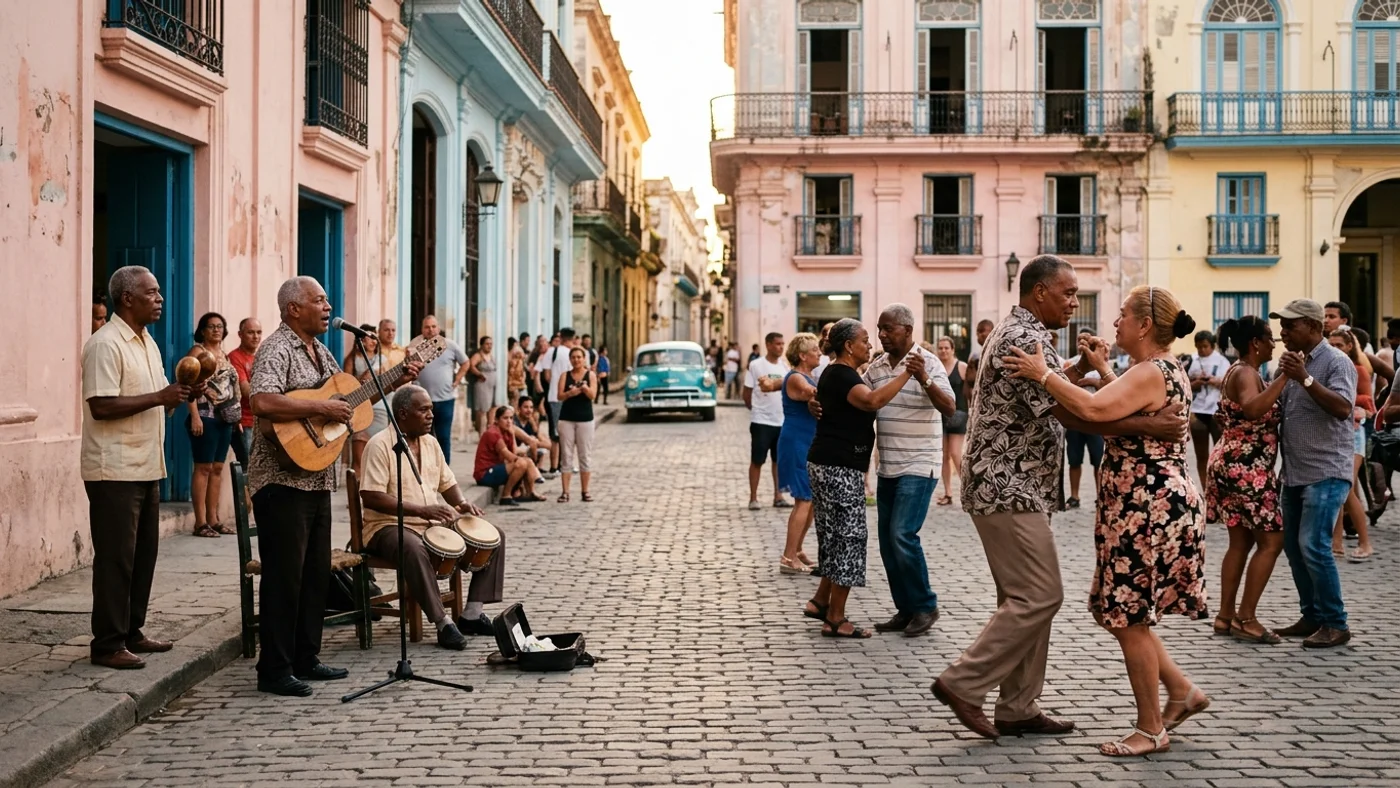
Havana is not a salsa city in the international sense. Cubans dance casino, son, timba, rumba, rueda, and contemporary fusion styles — to music that predates, underpins, and extends well beyond what the global “salsa” industry calls salsa. Treating Havana as just another salsa destination misses the point. This is the source — the city whose musical traditions fed every scene from Spanish Harlem to Cali to Tokyo, the country where rumba came from African roots into the modern Cuban canon, the place where casino and rueda developed as social practices rooted in neighborhoods and family parties rather than in dance schools. This guide covers the reality of dancing in Havana as an international visitor — the venues, the cultural context, the music, and how to engage with the scene respectfully.
Table of Contents
- What Havana’s Dance Scene Actually Is
- Casino, Timba, Son, Rumba: A Short Music Primer
- The Iconic Venues
- Callejón de Hamel: Sunday Rumba
- Rueda de Casino and Community Scenes
- A Night-by-Night Rhythm
- What to Expect at a Havana Dance Event
- Taking Classes in Havana
- Festivals
- Cultural Context and Respectful Engagement
- Logistics, Safety, and Practical Tips
- Combining Havana with Other Trips
- Find Events
- FAQ
What Havana’s Dance Scene Actually Is
The word “salsa” is a marketing term. It was popularized in the early 1970s by Fania Records in New York to package a musical movement — much of it Cuban in origin, some Puerto Rican, with additions from Nuyorican jazz fusion — for international audiences. The term stuck. Today it describes a genre, a global dance industry, and a congress circuit that stretches from Barcelona to Manila.
Cuba itself does not use the word in the same way. Cubans dance casino — a partner dance that developed in the 1950s Havana Casino Deportivo and spread from there through the island’s social and family life. They listen and dance to timba, the contemporary Cuban dance-music genre that emerged in the 1980s and 1990s through bands like NG La Banda, Los Van Van, and Issac Delgado. They dance son, the older Cuban partner tradition that underpins casino and nearly everything else. They practice rumba, the African-rooted folkloric percussion-and-dance tradition that gives Havana its Sunday afternoon street-gathering culture. And they dance contemporary fusion forms — reparto, cuban hip-hop, and various urban styles that share space with the traditional genres.
What this means for an international dancer: you are not going to Havana to dance “salsa” in the sense you know it from a European festival. You are going to dance Cuban social-dance traditions in the city where they live. The two things overlap significantly — casino is danceable to much of what passes for salsa music — but they are not identical. Calling casino “Cuban salsa” is slightly backwards; it is more accurate to say that what the world calls salsa is a specific diaspora expression of musical traditions that Cubans know by their proper names.
This framing matters because it shapes how you engage with the scene. If you arrive expecting a congress-style weekly social, you will be disappointed. If you arrive wanting to experience the music and dance as Cubans live with them, you will have one of the richest dance trips of your life. Our Cuban salsa vs LA style vs NY style guide covers the broader stylistic context.
Casino, Timba, Son, Rumba: A Short Music Primer
A quick vocabulary guide to what you will hear and dance to in Havana.
Casino is the partner dance — the Cuban version of what the world has labeled salsa. It is circular rather than slot-based, close rather than open, hand-led rather than body-led, and improvisational rather than pattern-catalog. Dancers rotate around a shared center. Turns happen through the hand connection. The dance responds to what the music is doing, often dropping out during percussion breaks and re-engaging when the music builds.
Timba is the music most casino dancers play and dance to today. It evolved from classic Cuban salsa (son-based) in the 1980s and 1990s, incorporating funk, jazz, hip-hop, and contemporary electronic elements. Timba is rhythmically denser than international salsa, often with long percussion breaks, dramatic structural shifts, and lyrics in rapid Cuban Spanish. Bands like Los Van Van, NG La Banda, Issac Delgado, Bamboleo, and younger acts like Alexander Abreu (Havana d’Primera) and Adalberto Álvarez y Su Son define the current timba landscape.
Son is the older musical tradition — Cuban guitar-and-percussion music that dates back over a century. Son is slower, more melodic, and more melodically structured than timba. You will hear son at places like Casa de la Música during the earlier hours, at son-specific venues, and throughout Old Havana’s daytime music scene. The partner dance to son is closer to casino in footwork but with a slower, more traditional feel.
Rumba is the African-rooted folkloric tradition — percussion-based, call-and-response vocals, and dance forms (yambú, guaguancó, columbia) that are closer to ritual performance than partner social dance. Rumba in its pure form is not a partner dance you will be invited into, but witnessing it is one of the essential Havana experiences. Callejón de Hamel on Sunday afternoons is the best-known rumba venue.
Rueda de casino is the circle dance — multiple casino couples dance together while a caller names moves that everyone executes simultaneously, often passing partners as instructed. Rueda is a huge part of Cuban social-dance culture, developed in the 1950s and refined into a community practice. Formal rueda gatherings in Havana are less common than at international congress events, but the cultural influence is everywhere.
Other genres to know: bolero (romantic slow Cuban ballad dance), danzón (the classical Cuban ballroom tradition — older, more formal), cha-cha-chá (Cuban 1950s mid-tempo partner dance), mambo (Pérez Prado’s Cuban-Mexican big-band tradition), and reggaetón and reparto (contemporary urban genres mixed into most nightlife).
The Iconic Venues
Several venues anchor the Havana dance scene for international visitors. Programming shifts based on band schedules and political/cultural climate; check current information close to your trip.
Casa de la Música
Casa de la Música operates two venues — one in Miramar (west of central Havana) and one on Galiano Street in Centro Habana. Both host professional Cuban bands playing timba and classic Cuban salsa most nights of the week. The Miramar location is larger and somewhat more polished; the Centro Habana location has a more intimate, more local feel.
These are the most famous live-music venues in the city for international dancers. You pay a cover, you walk in, and you have a live Cuban band playing to a mixed crowd of dancers, locals, and tourists. The dance floor is proper, the music is live and high-quality, and on a good night you will see some of the best casineros in Havana working with the band.
Practical notes: Casa de la Música is expensive by Cuban standards (covers in the 20 to 30 CUC range historically). The crowd skews heavily toward tourists, especially on weekends. Not all dancing will be at local-scene level — many attendees are visitors like you. Still, for a definitive Havana live-music dance experience, this is the first stop.
1830 (Club 1830)
Club 1830 in Vedado (the western part of central Havana) is an outdoor/terrace dance club that has been running for decades. It serves as a more relaxed, slightly more local alternative to Casa de la Música — cover is lower, crowd is more mixed, and the atmosphere is more neighborhood-bar than live-music showcase. Live bands play on some nights; DJs on others. Good floor and steady attendance.
Fábrica de Arte Cubano (FAC)
FAC is not a dance venue primarily — it is an art space in a former cooking-oil factory in Vedado — but it programs a huge range of music, performance, and late-night party events, several of which include significant dance components. Wednesdays and Thursdays are the bigger nights. Expect a younger, more arts-forward crowd and a mix of Cuban and international DJs and musicians. Dancing happens but is not the primary draw.
La Zorra y El Cuervo
La Zorra y El Cuervo on 23rd Avenue in Vedado is Havana’s best-known jazz club — small, intimate, legendary for its Cuban jazz programming. Not primarily a dance venue, but understanding the music ecosystem is essential to engaging with the Cuban dance scene, and a night of Cuban jazz at La Zorra is part of the education.
Jazz Café, El Sauce, and Smaller Clubs
Jazz Café, El Sauce (in Miramar, a dedicated outdoor club), and various smaller venues across the city run weekly or biweekly live Cuban music events. Programming rotates with artist availability. Check local listings or ask at your accommodation.
Paladares and Restaurants with Music
Many of Havana’s private restaurants (paladares) have small music performances on specific nights — trios or quartets playing son, trova, or acoustic Cuban music. These are more for listening and conversation than for dancing, but they are part of how the music lives in the city. Buena Vista Social Club-style acoustic performances in Old Havana paladares are a charming evening but not where you will be dancing casino.
Callejón de Hamel: Sunday Rumba
The most famous free dance-related experience in Havana is Callejón de Hamel’s Sunday afternoon rumba. Callejón de Hamel is a short, vibrantly-painted alley in Centro Habana decorated with Afro-Cuban religious and folkloric art by the artist Salvador González. On Sunday afternoons (typically around noon to 3pm), rumba bands and dancers perform in the alley to a crowd of locals and visitors crammed into the small space.
What to expect:
- Free. No cover. Tipping the performers is strongly encouraged and good form.
- Crowded. Small alley, packed audience. Arrive by 11:30am for good viewing positions.
- Authentic rumba. This is not casino — this is folkloric rumba, performed by rumberos (professional rumba performers) in the tradition’s call-and-response structure. You will hear yambú (slower, older form), guaguancó (medium-tempo with male-female partner play), and occasionally columbia (fast, acrobatic, traditionally male solo form).
- Crowd participation. Spectators may be invited to dance at certain points, but you are not expected to know the tradition — this is a cultural event to witness first and participate in only if specifically welcomed.
- Cultural sensitivity. Rumba has roots in Afro-Cuban religious and social traditions. Be respectful. Do not photograph performers aggressively, do not treat it as a tourist photo op, and tip the performers generously.
For anyone interested in the roots of Cuban music and dance, Callejón de Hamel on a Sunday is the single most important free cultural experience in the city. It is unmissable.
Rueda de Casino and Community Scenes
Outside the tourist-facing venues, Havana has a real community dance life — weekend family parties, neighborhood social gatherings, rueda circles that meet informally, and private practicas run by dance schools or community groups. This scene is harder for a short-term visitor to access because it runs on personal networks rather than public listings.
Entry points:
- Take classes. Any reputable dance school in Havana will connect you to their social network, which often includes weekly practicas and community events that visitors can attend.
- Ask your accommodation. Casa particular hosts (private homeowners renting rooms) are often well-connected locals who can advise on family parties or specific weekend events.
- Respectful presence at smaller venues. Some venues like El Jelengue de Areíto or community-level dance spots run more local-oriented events. Be respectful, tip the musicians, dance if invited.
What rueda looks like in Havana: imagine a group of 10 or 20 dancers in a circle, with a caller shouting move names (“Enchufla!” “Dame!” “Vacila!”), and everyone executing the called move simultaneously while passing partners. The move vocabulary is large and regional — a rueda in Havana will use different calls than a rueda in Miami or Madrid. Jumping into a rueda cold requires knowing some of the core moves; taking a rueda-focused class during your trip is the fastest way in.
A Night-by-Night Rhythm
Programming in Havana shifts with band availability, political/cultural climate, and seasonal factors. These are general rhythms rather than strict weekly listings; verify close to your trip.
Sunday. The quiet day for most venues but the biggest day for rumba and folkloric music. Callejón de Hamel is the Sunday event — unmissable. Sunday evening programming at Casa de la Música and others varies.
Monday. Mid-level. Fewer big venues open, but specific weekly programs run at some spots. Use Monday for classes, to rest, or to explore Old Havana’s daytime music scene.
Tuesday. Picking up. Some Casa de la Música and smaller venue programming. Not peak.
Wednesday. Good midweek — FAC runs heavily on Wednesdays, Casa de la Música usually has programming, and 1830 sees regular attendance.
Thursday. Warming into the weekend. FAC, Casa de la Música, and various clubs run strong programming.
Friday. Peak weekend. Casa de la Música is fully booked; 1830 is active; multiple concert and dance venues run headline acts.
Saturday. Also peak, with the broadest spread across venues. Most dance travelers plan Friday-Saturday as the core of their Havana week.
The pattern: plan a Friday-Saturday-Sunday core (big nights plus Callejón), add a Wednesday FAC experience, keep Monday-Tuesday flexible for classes, day-exploring, and smaller venues.
What to Expect at a Havana Dance Event
Dress. Casa de la Música and 1830 lean dressier than the average Cuban social moment. Not formal — think nice jeans or slacks with a proper shirt, real shoes. Women wear dresses or nice pants. Dance shoes are appreciated but not required at most spots; leather-soled street shoes work fine. FAC is more artsy-casual.
Arrival times. Cuban nightlife runs late. Shows at Casa de la Música typically start around 10:30 or 11pm; peak energy is midnight to 2am. Do not arrive at 8pm expecting a full room.
Cover charges. Have shifted significantly with Cuba’s currency reforms over the past decade. Historically, tourist-facing venues charged 10 to 30 CUC (convertible currency). The dual-currency system has changed; CUC was officially eliminated in 2021 and prices are now in Cuban peso (CUP) or dollar equivalents, depending on the venue. Budget 20 to 40 USD equivalent for cover at major venues.
Drinks. Rum is the national pour — Havana Club is the standard, and a rum drink is the default order. Mojitos and daiquiris were invented here; ordering one in Havana is basic tourism. Prices at tourist-facing venues run 5 to 15 USD equivalent.
Asking to dance. Standard Latin norms apply — eye contact, a polite approach, a respectful hand gesture. Verbal asks work. Cubans are generally open to dancing with visitors who show interest and respect for the music. A polite decline is accepted without issue.
Dance level. Extremely variable. Live-music venues mix professional performers, scene regulars, and tourists who have never danced casino. You will encounter people who are exceptional and people who are just there for the music. Adjust expectations by room.
The jineterismo issue. Havana has a long-standing phenomenon where local dancers (often well-trained) approach tourists at dance venues with the unspoken expectation of being paid, bought drinks, or otherwise compensated. This is a function of Cuba’s unique economic reality — professional dancers sometimes earn more from tourist-dancing-partners than from official work. Some of these interactions are warm and friendly; some have an uncomfortable transactional edge. Use your own judgment, be respectful, and do not assume every dance invitation from a local comes with expectations — most do not.
Music and song rotation. Live bands play long sets (songs of 6 to 10 minutes with extended percussion breaks). DJ sets run shorter tracks. One song per partner is typical at live-music venues because songs are long; two songs per partner at DJ nights is standard. Our dance floor etiquette guide covers global norms.
Taking Classes in Havana
One of the best uses of a Havana trip is taking classes. Instruction in casino, rueda, son, and rumba is available from some of the most experienced teachers in the world, and prices are low by international standards.
Expected rates (2025-2026, in dollar-equivalents):
- Group classes: 5 to 15 USD per class
- Private classes: 15 to 40 USD per hour, depending on teacher reputation
- Intensive packages: 150 to 400 USD for a week of daily instruction
Recommended approach:
- Book a dedicated casino teacher for 3 to 5 private hours during your trip
- Take a rueda-focused group class if possible to learn the basic calls
- Consider a rumba-observation session with a teacher who can explain the tradition — rumba is better witnessed than danced for a short-term visitor
- Attend your teacher’s recommended social afterward to apply what you learned
Schools and individual teachers advertise through Instagram, Airbnb experiences, and word-of-mouth. Dance-focused accommodations (some casas particulares specialize in hosting dance travelers) can arrange referrals. Established schools like ISA dance programs, dance-focused Airbnb experiences, and long-standing independent teachers all operate in Havana.
Festivals
The Ritmo Cuba 2026 — the 8th edition of this international Cuban dance festival — runs in April 2026 and is one of the major anchor events for international visitors to Havana. Festivals like Ritmo Cuba program workshops with Cuban teachers, evening socials at partner venues, and day trips to cultural sites. For first-time visitors, scheduling a trip around a festival is one of the most efficient ways to experience Havana with built-in local connections and structured learning.
Other festivals and dance events rotate throughout the year — Baila en Cuba and similar events bring international dancers for concentrated week-long programs. Our best salsa festivals 2026 guide covers the global calendar.
Cultural Context and Respectful Engagement
Dancing in Havana as an international visitor carries some responsibilities. The scene is embedded in a country with a complicated economic and political reality, a rich cultural heritage that predates Western dance-industry interest by centuries, and a community that has seen a lot of tourists pass through over the past 30 years. Engaging respectfully matters.
- Acknowledge the Cuban-ness. Do not call casino “Cuban salsa” as if it were a variant. It is not — it is its own tradition, from which much of what we call salsa descends. When you refer to the dance, use its actual name.
- Pay fairly. Dance teachers, musicians, and professional dancers in Cuba often rely on tourist income to supplement official wages. Tip generously. If a teacher is excellent, pay more than the advertised rate. Good tips genuinely change lives in Cuba’s economic context.
- Do not haggle musicians. Tip bands at live-music shows. A few dollars per set is expected and appreciated.
- Respect rumba. The tradition has religious and cultural roots in Afro-Cuban communities. Treat Callejón de Hamel and other rumba venues as cultural events first, photo opportunities second or not at all.
- Do not assume English. Spanish is the language. Basic Spanish fluency improves the trip enormously and signals respect for the community.
- Read Cuban music history. Understand where what you are dancing to came from — Cuban son, Afro-Cuban jazz traditions, the evolution into salsa and timba. A little historical depth makes the entire trip richer.
- Be careful about photos. Candid photos of dancers and musicians in private settings are generally not welcome without permission. At public shows and festivals, photography is normal but still polite to ask.
- Support Cuban businesses. Eat at paladares (private restaurants) rather than state-run hotels when possible. Stay at casas particulares. Take classes from independent teachers. The dollar that flows directly to a Cuban family is worth more than the one that flows to a state hotel.
Logistics, Safety, and Practical Tips
Visa and entry. Most non-US travelers receive a tourist card or equivalent on arrival. US citizens face specific restrictions — check current State Department guidance before booking.
Currency. The currency system has shifted. CUC (convertible peso) was officially eliminated in 2021; now the CUP (Cuban peso) and USD/EUR are the practical currencies for tourists. Bring Euros or Canadian dollars — US dollars work but face unofficial surcharges. ATMs are unreliable for international cards; bring enough cash for your entire trip.
Internet. Severely limited by global standards. WiFi hotspots in hotels and some public spaces work but are slow and require purchased cards. Many casas particulares have WiFi (check before booking). Plan to be mostly offline.
Accommodations. Casas particulares (private homes renting rooms) are the best choice for dance travelers — warmer, cheaper, more culturally immersive than hotels. Many are within walking distance of Centro Habana and Vedado’s main dance venues.
Transport. Taxis (the classic American 1950s cars are commonly tourist taxis; cheaper taxis colectivos share rides along set routes) are the main transport. Havana is walkable in its central neighborhoods; late-night taxi rides home are standard. Agree on prices before getting in. Budget 5 to 15 USD for most intra-city taxi rides.
Safety. Low violent-crime rates by Latin American standards. Petty theft, scams, and tourist hustles are the realistic risks. Stick to main streets at night. Do not accept “guide” services from strangers. Keep cash secure. Women traveling alone report Havana as safer than most Caribbean cities.
Weather. Subtropical. Hot and humid most of the year. Hurricane season June through November. December through April is the best weather for visitors — cooler and drier.
Health. Mosquito precautions (Cuba has periodic dengue and Zika outbreaks). Bring sufficient prescription medications from home — pharmacy availability is limited. Drink bottled water. Food at reputable paladares is safe.
Language. Spanish essential. Basic conversational Spanish dramatically improves the trip. English is spoken only at some tourist-facing venues and accommodations.
Electricity. 110V and 220V outlets both exist; US-style plugs common. Bring adapters for European devices.
Combining Havana with Other Trips
Havana pairs well with several other Caribbean and Latin-American dance destinations.
Havana plus Santo Domingo. Two essential trips for any dancer interested in Caribbean music roots. Casino-timba-son in Havana, Traditional bachata-merengue in Santo Domingo. Our bachata dancing in Santo Domingo guide covers the DR side.
Havana plus Mexico City. Mexico City has deep historical ties to Cuban music — the 1940s-1950s mambo era was partly based there. A trip that combines CDMX’s historical ballroom culture (Salón Los Ángeles) with Havana’s living tradition makes a rich two-destination itinerary. Our salsa dancing in Mexico City guide covers the Mexico side.
Havana plus Medellín or Cali. For a Latin-American music immersion, pairing Havana with Colombian salsa cities gives you the Caribbean source plus the Colombian cali-style evolution. Our salsa dancing in Medellín guide covers that side.
Havana plus Miami (if practical). Miami is the closest approximation to Cuban culture in the US and the natural transit hub for Caribbean travel. A trip combining Havana with Miami’s Cuban-American scene (Ball & Chain, Little Havana) adds the diaspora layer. Our salsa dancing in Miami guide covers Miami. Note that US-Cuba flights and policies are subject to frequent change.
Havana plus Jamaica or other Caribbean islands. Reggae, mento, and dancehall traditions in Jamaica complement Cuban music traditions well for a broader Caribbean music trip, though the dance cultures are very different.
Find Events
Listings on our site will grow as the Havana scene becomes more documented online. Right now the Havana scene is less systematically documented than European or North American scenes, so direct contact with casas particulares, dance schools, and specific venues often yields more accurate current information than public listings. Check our festival calendar for major Cuban events like Ritmo Cuba. For broader Latin-American and Caribbean context, our salsa dancing in Medellín, salsa dancing in Mexico City, and bachata dancing in Santo Domingo guides pair well with a Havana trip. Use the interactive map to see venue locations across the city.
FAQ
Is Havana a salsa city?
Yes and no. Cubans do not call what they dance “salsa” — they dance casino (what the international scene calls “Cuban salsa”), to music that ranges from son and timba to Latin jazz and mambo. What the world calls “salsa” was largely a 1970s New York industry term, named after the Fania Records marketing of music that originated in Cuba and Puerto Rico. When you dance in Havana, you are dancing with the source material. Casino, rueda, timba, son, and rumba are all distinct traditions — not variants of an international “salsa” — and understanding the distinction is the first step in engaging with the Havana scene respectfully. Our Cuban salsa vs LA style vs NY style guide covers the broader style context.
Where is the best place to dance in Havana?
Casa de la Música (two locations — Miramar and Galiano, Centro Habana) is the most famous live-music venue for dancers in the city, with professional Cuban bands playing timba most nights. 1830 (Club 1830) in Vedado runs a long-running outdoor-club scene with live Cuban music. Callejón de Hamel every Sunday hosts open-air rumba — the most iconic free cultural experience in the city. Beyond these anchors, smaller venues like Fábrica de Arte Cubano (FAC), La Zorra y El Cuervo, and specific neighborhood bars and paladares add to the weekly circuit.
What style of salsa or dancing should I know before going to Havana?
Casino, ideally — the circular, partner-close, improvisational Cuban style that the locals dance. If you come from an LA on1 or NY on2 background, your slot-based patterns will feel awkward in Cuban rooms. Learn some casino basics before you go, or plan to take classes during your stay — Havana has excellent dance instructors available for affordable private lessons. Beyond casino, familiarity with timba music (the contemporary Cuban big-band genre) helps enormously. And do not expect Sensual bachata or any European congress-style dance formats — they are not part of the Cuban social-dance landscape.
Is Havana safe for dance travelers?
Havana is one of the safest major cities in the Caribbean in terms of violent crime — lower rates than most US or Latin American capitals. Petty theft, scams, and tourist-targeted hustles are the more realistic concerns. Taxi fare overcharging is common; agree on prices before rides. Stick to main streets at night in Centro Habana and Vedado. The dance community is welcoming and safe. The bigger practical concerns for travelers are logistical — limited internet, dual-currency economy, US travel restrictions for American citizens — not safety.
What should I know about US-Cuba travel before planning a trip?
US travelers face specific restrictions on travel to Cuba that shift with political administrations. Before booking, check current State Department guidance and the Office of Foreign Assets Control rules. Most non-American travelers (EU, UK, Canada, Latin America, most other passports) can visit Cuba with a simple tourist card. American travelers typically need to qualify under one of 12 authorized categories of travel. This guide is written for a general international dance audience — American readers should verify their eligibility before proceeding.