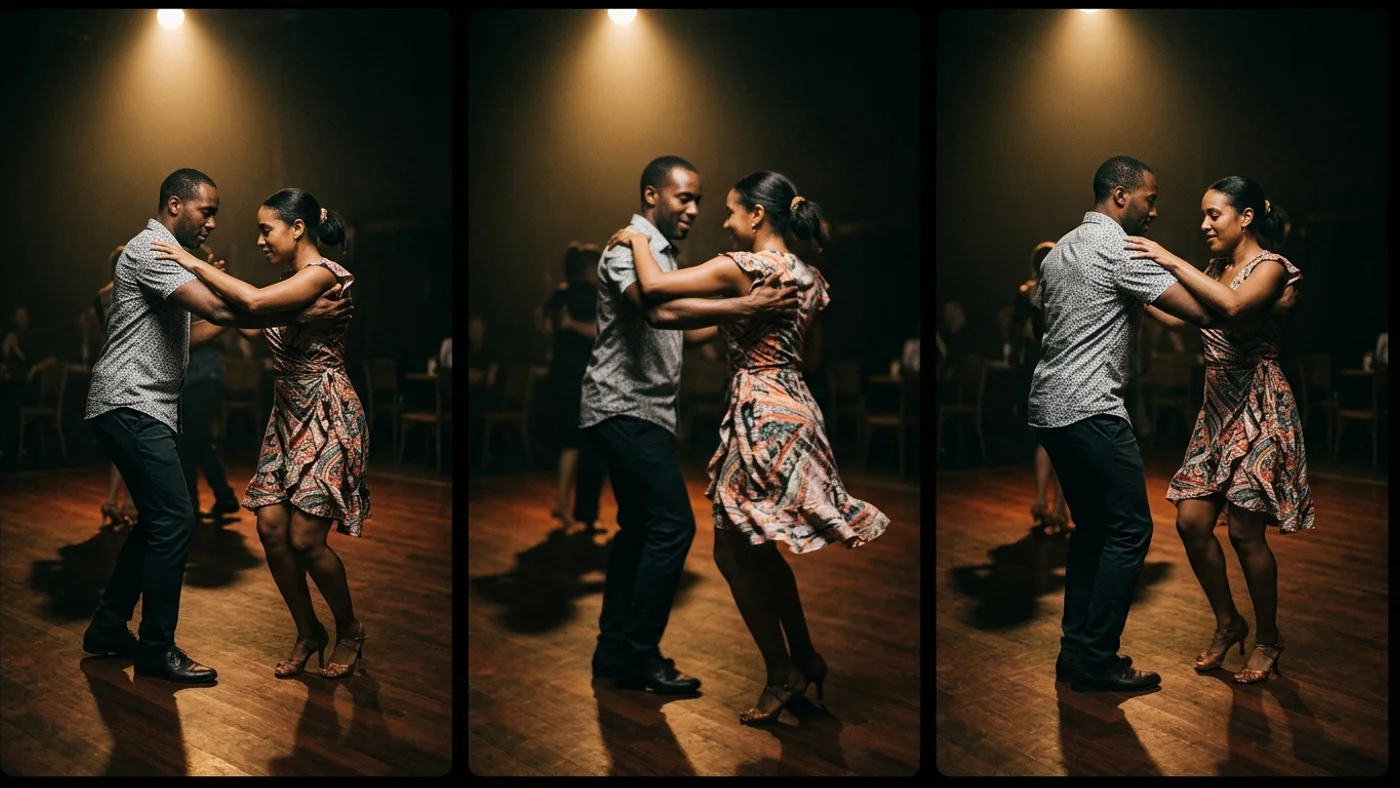
The first time someone asked me what kind of salsa I danced, I froze. I had been taking classes for three months. I knew the basic step. I could do a cross-body lead without panic. But I had no idea whether the thing I was doing was called Cuban, LA, On1, On2, or something else entirely. I went home that night and fell down a YouTube rabbit hole. Two hours later I came out more confused than when I started.
If you are in the same place — dancing for a few months, hearing names thrown around, wondering whether you should “pick a style” — this guide is for you. There are three dominant salsa styles in the world right now. Each has its own history, its own music, its own body posture, and its own scenes. Knowing the difference does not just help you sound informed at a social. It helps you understand what is happening when you step onto a floor in a new city and everything feels slightly off.
A Quick Family Tree
Before the styles, a little history. All modern salsa descends from Cuban son — a partner dance that developed in eastern Cuba in the early 20th century, built on the rhythmic pattern called clave. Son mixed with rumba, mambo, and cha-cha-cha in Cuba, moved to New York via Cuban musicians and the 1950s mambo craze, and got renamed “salsa” in New York in the 1960s and 70s as a marketing umbrella for the Latin music explosion happening in the Bronx and Spanish Harlem.
From that New York scene, salsa split. New York mambo dancers like Eddie Torres refined a timing system called On2 that emphasised the conga pattern. In the 1980s and 90s, a Los Angeles scene developed around Luis Vazquez and the Vazquez brothers that danced in a “slot” with dramatic theatrical spins — this became LA style, or On1. Meanwhile, back in Cuba, the Casino style was evolving on its own, largely untouched by the American scenes, rooted in circular partner work and group dances called rueda.
Today, these three streams — Cuban Casino, LA On1, and New York On2 — are the main families you will encounter at any international social. Each tells you something about the dancers, the music choices, and the flavor of the scene.
Cuban Salsa (Casino)
Cuban salsa, more properly called Casino, is the style that grew up inside Cuba while the rest of the salsa world was developing abroad. It is circular, grounded, improvisational, and deeply tied to Cuban culture and music. Watch a Cuban salsa social and the first thing you will notice is that couples turn around a shared axis. There is no slot, no line, no forward-and-back. Partners orbit each other.
The basic step in Casino uses the same 8-count structure as any salsa, but the footwork is more relaxed — you can step almost anywhere as long as you keep the pulse. The break step can land forward, back, to the side, or even in place. Cuban dancers describe it as “walking in the music” rather than executing a pattern. The upper body stays soft. The knees stay slightly bent. The hips move, but not as a performance — more as a natural consequence of the weight transfer. Watch a skilled Cuban lead and their shoulders barely move while everything below the ribs is alive.
The hand connection is also different. Cuban leads tend to use both hands and move through complex arm “passes” and “locks” — the signature pretzel-like patterns where partners wind up with their arms tangled before unwinding smoothly. The follow’s job is not to spin cleanly from point A to point B. It is to flow through the shape while keeping the connection and the pulse.
Rueda de Casino is Cuban salsa’s signature format. Multiple couples form a circle, and a caller — the líder — shouts out moves that everyone executes at the same time, often rotating partners on each call. “Dame” (give me) sends partners one position clockwise. “Enchufla” is a turn pattern. “Setenta” is a classic arm lock. Rueda is a joyful, social, wildly fun format, and a good rueda caller can keep a floor of twenty people synchronised for half an hour. It is the closest salsa comes to group dance.
Music: Cuban salsa is typically danced to timba, son, songo, and the harder-edged Cuban dance music of groups like Los Van Van, Havana D’Primera, Issac Delgado, and Alexander Abreu. This music has a driving percussion section, syncopated breaks, and call-and-response vocals that reward a dancer who knows how to pause and punch the accents. Timba in particular has gaps and stops where the music drops out entirely and the dancers freeze — a moment of theatre on the social floor.
Where you find it: Havana is the source, obviously. But Cuban Casino scenes are strong across Europe, especially in places with historical Cuban ties or left-leaning cultural traditions. Paris has a massive Cuban scene, as do Madrid and Barcelona. In the Americas, Mexico City leans Cuban, as do most Colombian cities like Medellin. German Cuban scenes in Berlin and Munich are legendary. If you travel to a European or Latin American city and walk into the main salsa night, there is a good chance you will be dancing Casino.
LA Style (On1)
LA style is the most visually recognisable salsa in the world. It is the style you have seen in music videos, on “So You Think You Can Dance,” and in every salsa performance on social media. It is also the most widely taught style in dance schools outside of Cuba and Colombia. If you have taken salsa classes anywhere in the English-speaking world in the last twenty years, you were probably learning LA On1.
The defining feature of LA style is the slot. Two dancers face each other across an imaginary line. On the lead’s forward break, the follow steps back along the slot. On the return, they switch positions. Most turn patterns are built around cross-body leads, where the lead steps out of the slot to let the follow pass through, then returns to face them again. The slot gives LA style its clean, theatrical look — every move travels along a visible axis.
The timing is “On1” — meaning the lead breaks forward on count 1 of the 8-count phrase. The rhythm in your feet goes: step on 1, step on 2, step on 3, pause on 4, step on 5, step on 6, step on 7, pause on 8. That pause on 4 and 8 is where styling happens — shoulder rolls, hand flicks, arm styling. The overall feel is sharp and punctuated, with every beat accented.
LA style is characterised by dramatic spins — multiple-rotation turns, drops, dips, and tricks. It is the style that most rewards technical training. A polished LA dancer looks like a performer, even in a social setting. The flip side: LA style has the steepest learning curve if you want to execute the signature moves well. Basic LA salsa is accessible, but the signature look — those long held spins and clean lines — takes years.
Music: LA style is typically danced to salsa romántica, Puerto Rican salsa dura, and modern commercial salsa. Think Marc Anthony, Gilberto Santa Rosa, Victor Manuelle, La India, and classic Fania catalog from Willie Colón, Hector Lavoe, and Ruben Blades. The tempo is usually steady and predictable, which suits the pattern-based vocabulary of the style. Songs are chosen for their clean structure — clear verses, clear choruses, predictable breaks — rather than for unpredictability.
Where you find it: LA style dominates most English-speaking salsa scenes. Los Angeles is obviously the source. New York has significant LA style alongside its native On2 scene. London, Berlin, and Amsterdam are heavily LA-leaning. Sydney, Tokyo, and Hong Kong all have dominant LA scenes. If you are in an international city and walk into a salsa social, the default is probably LA On1.
New York Style (On2)
New York style, also called New York mambo or On2, is the most sophisticated salsa style — and I say that as a statement of fact, not favouritism. It is slower to develop, harder to teach, and more demanding of the dancer’s musical ear than either of the other two. It is also, in my opinion, the most beautiful when done well.
The difference is in the timing. On2 dancers break on count 2 (or count 6 on the reverse), which is where the conga’s tumbao pattern hits. The tumbao is a rhythmic slap that falls between the downbeats of the clave. When you dance On2, you are dancing inside the conga pattern rather than on top of the brass or the clave. The music feels different. The steps feel different. The pauses land in different places. Many dancers describe On2 as “feeling the music from the inside.”
Technically, On2 looks similar to LA style at first glance. It is danced in a slot. It uses cross-body leads. The turn patterns are often identical. But the accents are completely different. Where LA style hits on counts 1 and 5, On2 hits on 2 and 6. The result is a smoother, more elastic feel — less punctuated, more flowing. Good On2 dancers seem to float in and out of the beat rather than landing on top of it.
On2 is the style developed by Eddie Torres in New York in the 1970s and 80s. Torres studied with the legendary mambo dancer Tito Puente and formalised the timing into a teachable system. Before Torres, mambo dancers in New York broke on different counts depending on the club, the teacher, and the musician. Torres’s genius was creating a consistent system that matched the music’s internal structure. The result is sometimes called “Eddie Torres style” or “ET On2” for this reason.
Music: On2 dancers tend to prefer classic New York salsa — Fania-era Willie Colón, Hector Lavoe, Cheo Feliciano — alongside mambo classics from Tito Puente and Machito. The best On2 DJs mix in older mambo and son tracks that reveal the conga pattern most clearly. Modern salsa romántica gets played too, but the slower, more complex classics are where On2 dancers come alive.
Where you find it: New York is the home and heart of On2. The scene there — anchored by clubs like the old Copacabana and current mambo nights across Manhattan and the Bronx — is unique in the world. Miami has a strong On2 scene alongside its Cuban majority. Beyond the US, On2 has small but dedicated followings in most major European cities, particularly London, Paris, and Milan. Dedicated On2 weekly socials are rarer than LA or Cuban, so if you want to learn it properly, you often need to seek out specific teachers or travel to festivals.
Side by Side: Which Is Which?
Here is a rough cheat sheet for telling the three apart at a glance.
If the dancers are moving in circles, orbiting each other with tangled arms, and you hear a caller shouting short Spanish phrases — it is Cuban/Rueda.
If the dancers are moving along a clear line with big dramatic spins, multiple rotations, and the footwork looks sharp and staccato — it is LA On1.
If the dancers are moving along a line but the whole thing looks smoother, more melodic, and the accents seem to land slightly “late” to your ear — it is New York On2.
You can also listen for the timing. In the 8-count phrase, watch where the leader’s forward break lands. If it is on count 1 — LA. If it is on count 2 — New York. If you cannot tell, because the break keeps changing direction, it is probably Cuban.
And if the music choice is telling you something: timba with big percussion breaks and gaps is Cuban music. Polished salsa romántica is most likely LA. Older Fania-era tracks and mambo classics signal On2.
Which Style Should You Learn?
This is the question every beginner asks, and I have a firm opinion: learn whatever is strongest in your city. If the most popular weekly social near you is Cuban, start with Cuban. If the school down your street teaches LA On1, start there. The style you can practice four times a week at real socials with real partners will always outrun the “correct” style you learn in isolation.
If you genuinely have all three options locally — which is rare outside of New York, Miami, London, Paris, or Madrid — here is a rough temperament guide. Dancers who love structure, clean lines, and technical spins tend to thrive in LA style. Dancers who love musicality and subtlety over theatrics gravitate toward On2. Dancers who love group energy, improvisation, and less-structured social connection lean Cuban. These are tendencies, not rules. Plenty of people love all three.
If you are a beginner reading this, I also want to say something honest: the question of style matters less than consistency. Any dancer who shows up to a social twice a week for six months will outpace a dancer who takes advanced workshops in their “perfect” style but only dances once a month. Pick something. Start. Adjust later.
For more on getting started, see our beginner’s guide to salsa, which covers the very first steps regardless of style.
Can You Learn More Than One?
Yes. Many dancers do, and learning a second style usually deepens the first. The partner-connection principles — weight transfer, frame, lead-follow tension — are universal. The footwork differences are small. What changes is the feel of the music and the timing cues.
That said, I would not recommend learning two styles at the same time in your first six months. Mixing On1 and On2 timing is especially confusing because your ear needs to internalise one system before it can switch between them. Start with one. Get comfortable. Then, maybe a year in, take workshops in a second style and let your body figure it out.
Many advanced dancers hold all three in their heads at once and adapt to whichever style their partner prefers. This is genuinely impressive and takes years. As a beginner, it is the wrong goal.
What About “Colombian Style”?
Fair question. Colombian salsa, particularly the Cali style from the city of Cali, is sometimes listed as a fourth major style. It deserves a mention. Cali salsa is lightning-fast, footwork-heavy, and built on rapid syncopations and tiny, intricate steps — the result of Colombian salsa’s history as a concert-ballroom style rather than a social-improvisational one. It is a joy to watch, and if you ever visit Cali, you will see some of the most technically impressive salsa in the world danced by teenagers in local academies.
For the purposes of this guide, Cali style is closely related to Cuban Casino in its social form (same 8-count, same circular quality), but with much faster footwork. At international socials outside of Colombia, pure Cali style is uncommon. If you are interested, the only way to really learn it is to spend time in Cali.
Where to Go Next
If you are curious where specific scenes lean, our city guides give you a sense of the local flavor before you travel. New York for On2 and a huge LA scene. Medellin for pure Cuban-style immersion. Los Angeles for the home of On1. London and Berlin for a mix of all three, heavy on LA. For festivals that expose you to every style in a single weekend, browse our best salsa festivals in 2026.
If you want to compare salsa with its sister dance — because most scenes run both styles on the same night — start with what is bachata dancing. The roots, the music, and the feel are completely different, but the community is often the same.
The truth about salsa styles is simpler than the Internet makes it sound. Pick the one you can practice. Dance it a lot. Learn a second one when the first one feels boring. You will be fine. There is no wrong way to love this music.
Browse salsa events worldwide to find your next social, or explore the full interactive map to see where each style is strongest around the world.