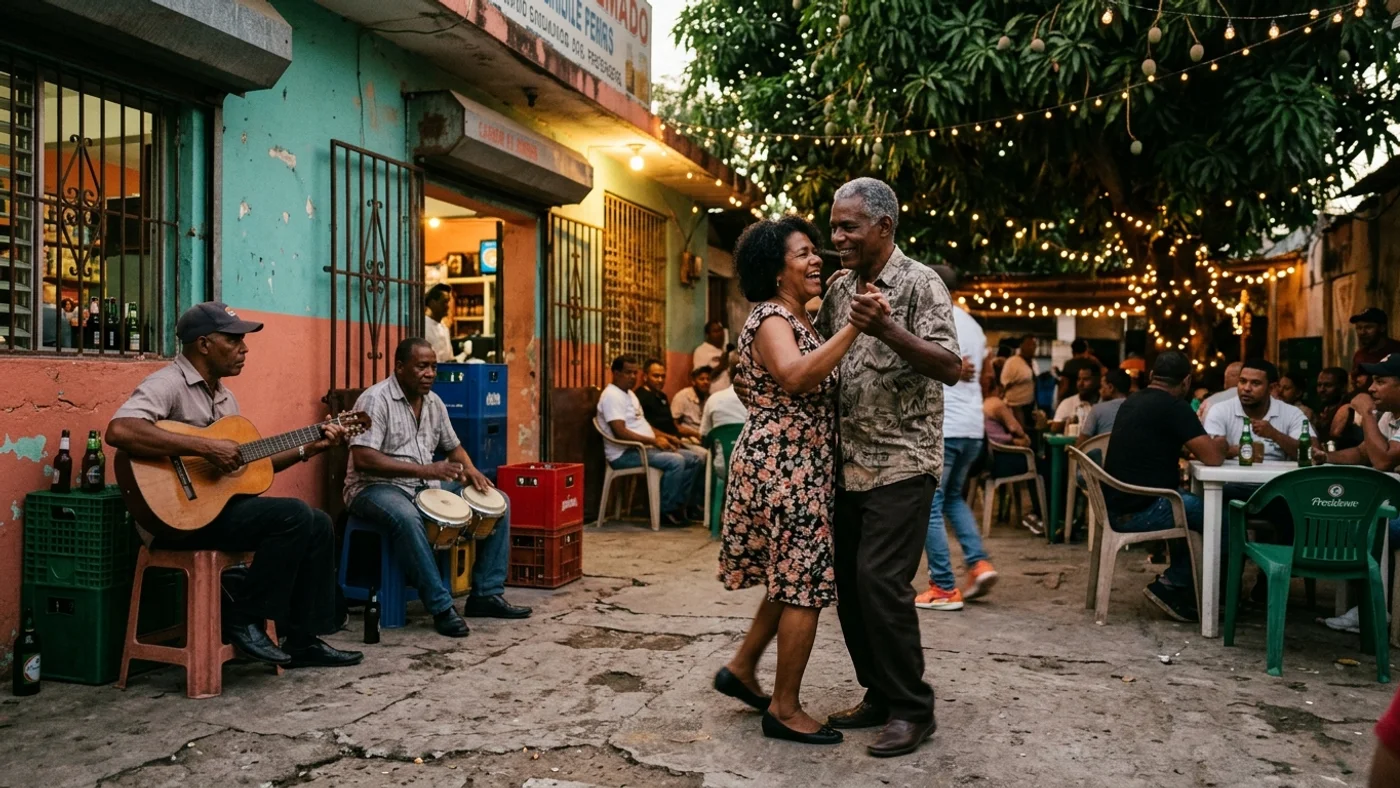
Santo Domingo is the source. Bachata as a genre was created in the rural Dominican Republic, exported to the United States and Europe by a diaspora, and reshaped into Sensual by Spanish dance teachers in Cadiz — but the thing itself, the music and the dance as Dominicans live with it, still belongs here. Any dancer who spends more than six months with bachata eventually needs to visit the country that made it. This guide covers the reality of dancing bachata in Santo Domingo: the weekly circuit in the Zona Colonial, the Bonyé Sunday-night ruins party that defines the city’s social-dance identity, the deep cultural gap between Traditional and Sensual that will reshape your understanding of the genre, and the practical logistics of a dance trip to the Dominican Republic.
Table of Contents
- Why Santo Domingo Matters in Bachata
- Traditional vs Sensual: Be Honest About What Is Here
- The Zona Colonial Weekly Circuit
- Bonyé at the Ruinas de San Francisco
- Jet Set and the Merengue Ballroom Tradition
- Colmados and the Community Scene
- A Night-by-Night Guide to Santo Domingo Bachata
- What to Expect at a Dominican Bachata Social
- Taking Classes in Santo Domingo
- Safety, Transport, and Practical Tips
- Combining Santo Domingo with Other Trips
- Find Events
- FAQ
Why Santo Domingo Matters in Bachata
Bachata emerged in the Dominican countryside in the 1960s, played on acoustic guitars in small rural gatherings — originally a folk guitar music looked down upon by Dominican urban society and excluded from most radio and TV until the late 1980s. The genre was largely kept alive in small bars called colmados (neighborhood corner stores that double as social hubs), in rural parties, and among working-class communities. For decades, middle-class Dominicans considered it música de amargue — “bitter music” — suited to heartbreak and the countryside, not for respectable dancing.
That changed in the 1990s and 2000s. Juan Luis Guerra’s Bachata Rosa album in 1990 brought bachata into the Dominican mainstream. Antony Santos, Raulin Rodriguez, Luis Vargas, and the generation that followed took the music worldwide. Aventura, formed in the Bronx, crossed it over globally. By the 2010s, bachata had become one of the best-known Latin music genres in the world, and the dance — danced first as Dominican-style, then reshaped into Sensual by Spanish teachers Korke and Judith in Cadiz — followed.
All of that global history started here. And the local scene in Santo Domingo today is what the music sounds like without the congress-circuit filter. When you walk into Bonyé on a Sunday evening and watch Dominicans dance bachata on the cobblestones in front of 16th-century ruins, you are watching the thing that everything else — every Sensual workshop, every Modern routine, every European festival party — is downstream of. That is worth the trip.
Our best cities for bachata in Latin America guide puts Santo Domingo at the top of the list for exactly this reason, and our bachata sensual vs traditional vs modern guide explains the stylistic lineage.
Traditional vs Sensual: Be Honest About What Is Here
This is the most important sentence in this guide: if you dance only Sensual bachata, Santo Domingo will challenge you. If you are open to that challenge, the trip will reshape how you understand the genre. If you are not, you will be frustrated for a week.
Dominican bachata is footwork-first. The dance is built around a bachata basic (side-together-side-tap on 1-2-3-4 and 5-6-7-tap) with the tap accented on the 4 and the 8, and a lot of dance happens in the footwork itself — cutting the time, playing with the tap, weight changes, syncopations. Upper body stays relatively quiet compared to Sensual. A good Dominican dancer can hold your hand, smile, and do almost nothing flashy above the waist while still making you feel every note of the song.
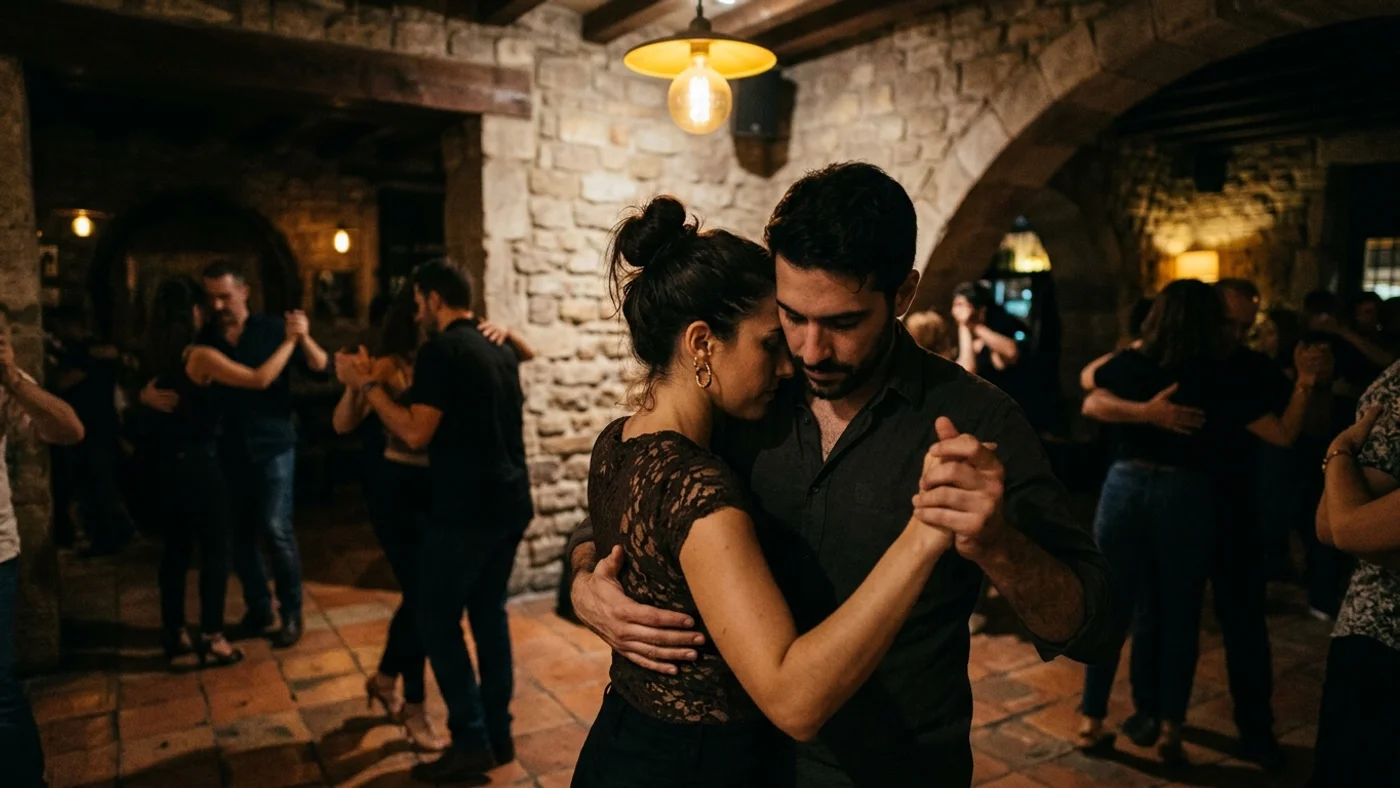
Connection is loose and free. The Dominican frame is not the close, upper-body-flush embrace of Sensual. It is more open, more hand-led, often with significant physical distance between partners. Leads send follows out and bring them back; follows improvise with footwork in the open space. Cross-body leads exist but are not the central organizational unit the way they are in Sensual or in slot-based salsa.
There is no body-wave vocabulary. Sensual’s body rolls, isolations, and wave chains are a Cadiz innovation. They do not appear in Dominican social dancing. If you arrive at Bonyé executing slow body waves and waiting for your partner to mirror them, you will confuse your partner and miss the music. Traditional has its own upper-body vocabulary (subtle hip accents, shoulder shimmies, mostly on accents of the song) but it is quieter and more intrinsic to the music.
The music is different. DJs in Santo Domingo play Dominican bachata — Luis Vargas, Frank Reyes, Raulin Rodriguez, El Chaval, Antony Santos, Juan Luis Guerra, Aventura’s older catalog, and modern bachata romantica from Romeo Santos and Prince Royce. Sensual-DJed tracks (Marc Anthony slowed remixes, European producers) are rare. The tempo tends to be faster than Sensual playlists, and the song structures reward footwork and rhythmic play rather than slow body-work.
The scene is not a congress scene. Santo Domingo does not have a dedicated weekly “bachata social” infrastructure in the way that Madrid or Berlin does. Dancing happens at bars, at Bonyé on Sundays, at weddings, at family parties, at colmados on the side of the road. There is no pre-social workshop, no wristband system, no rotation protocol. You show up, and if the music moves you, you dance.
This is not a criticism of Sensual — Sensual is a legitimate, beautiful, musical form in its own right. It is simply not what Dominicans dance. If you can go to Santo Domingo wanting to learn the Traditional version, you will have a transformative trip. If you can’t, go to Madrid or Miami instead.
The Zona Colonial Weekly Circuit
The Zona Colonial is Santo Domingo’s historic old town — 16th-century Spanish colonial architecture, cobblestone streets, the oldest European cathedral in the Americas, and a concentration of bars, restaurants, and music venues that make it the center of the tourist-accessible dance scene. Four venues anchor the weekly bachata circuit.
Bar & Museo del Ron Dominicano
Bar & Museo del Ron Dominicano runs a Latin night every Thursday, 9pm until late. The venue doubles as a rum museum and an atmospheric bar in the heart of the Zona Colonial. Live music some nights, DJ sets on others, with a mix of bachata and salsa in rotation. The crowd is a mix of Dominican locals and visitors, and the dancing spills into the outdoor courtyard area on good weather nights.
Merengue Club
Merengue Club runs a Friday Salsa Night (bachata included in the DJ rotation) from 9pm. Despite the name, bachata and salsa both get airtime — Dominican social-dance DJs routinely mix the two. The space is small and fills by midnight. The dance level on a good Friday night is high, mostly because of local regulars who come every week.
Azúcar Dance Center
Azúcar Dance Center runs a Friday Social from 8:45pm to midnight. This is a dedicated dance venue (not a bar) in a different part of town (Abraham Lincoln Avenue, west of the Zona Colonial). A pre-social class culture, a more dancer-focused crowd, and a proper floor. For a dancer who wants a more structured social that resembles what you might experience in Europe or the US, Azúcar is the closest Santo Domingo gets.
Ruinas de San Francisco (Bonyé — Sunday)
Ruinas de San Francisco hosts the Bonyé Sunday-evening social — covered in detail in the next section because it is important enough to deserve its own.
The combination of these four venues covers the main Zona Colonial weekly circuit. A visitor can build a dance week around Thursday at Ron Dominicano, Friday at Merengue Club or Azúcar, Saturday at whichever venue has a good line-up that week, and Sunday at Bonyé — and have a complete introduction to the local scene.
Bonyé at the Ruinas de San Francisco
If you only do one dance thing in Santo Domingo, do Bonyé.
Bonyé is the Sunday-evening open-air concert/party held in the cobblestone plaza in front of the Ruinas de San Francisco — the roofless shell of a 16th-century Franciscan monastery in the Zona Colonial. A band plays live Dominican music (bachata, merengue, son, salsa) from roughly 5pm or 6pm until around 10pm. Admission is free. The crowd is a mix of Dominican families, older neighborhood regulars who have been coming for years, tourists, and a solid contingent of local dancers.
The dancing happens in the plaza. People dance on the cobblestones. The Ruinas loom overhead. The music is live and usually excellent — the house band is a Dominican institution in its own right and plays to a crowd that knows every song. Kids dance with grandparents. A couple that looks 70 will be out-dancing the tourists. The feel is community rather than performance, which is exactly why it is so important.
Logistics:
- When: Sunday evenings. Typical hours are around 5:30pm to 10pm, though exact times vary. Arrive by 6:30pm to get oriented and see the scene fill.
- Cost: Free admission. Drinks from vendors around the plaza.
- Dress: Casual. Closed-toe shoes (cobblestones are rough on heels and bare feet). Clothes you can sweat in — it is outdoor, it is tropical, you will sweat.
- Floor: Cobblestones. Not a traditional dance floor. Leather-soled shoes or proper outdoor dance shoes work best. Flats or cushioned sneakers are fine.
- Crowd: Multigenerational, very Dominican. Tourists are welcome but not the majority.
- Expect: To be asked to dance, especially if you are a follow. Dominican leads in this context are warm and welcoming, and a polite decline is respected.
Bonyé is the single closest you will get to understanding what bachata and merengue mean to Dominicans as living social practices rather than as exported dance genres. Do not miss it.
Jet Set and the Merengue Ballroom Tradition
Jet Set is not in the Zona Colonial — it is in the Miraflores neighborhood, a taxi ride away — but any bachata or merengue dancer visiting Santo Domingo should consider one night there. Jet Set has been operating since the 1970s as a legendary dance club specializing in live merengue and bachata orchestras. It is one of the last surviving great Latin ballrooms of its era, and a Monday or Tuesday night here (when the famous live orchestra runs) is a trip back into the pre-digital dance-club world.
The experience:
- Live orchestra rather than DJ. Dominican mood music — merengue, bachata, occasionally salsa. The band is tight and plays long sets.
- Dress code. Dressier than the Zona Colonial. Real shoes, a nice shirt, proper pants or dress. Jet Set maintains an old-school standard.
- Dancing style. Heavy on Traditional partnered bachata and classic merengue. This is ballroom-partner-dance energy, not congress-social energy.
- Crowd. Mature, experienced, largely Dominican. Tourists are welcome but not the main demographic.
- Cost. Cover varies — typically 20 to 30 USD at the door depending on the night and the orchestra. Drinks at ballroom-club prices.
- Timing. Prime time is late — after 11pm, running until 3 or 4am on the big nights.
Merengue, not bachata, is technically the national dance of the Dominican Republic, and Jet Set is arguably the best place in the country to experience it with a live orchestra. For a bachata traveler who wants to understand the broader Dominican dance context, a Jet Set night adds something nowhere else can provide.
Colmados and the Community Scene
Colmados are the Dominican corner-store-and-bar combo: part small grocery, part social hub, part spontaneous dance floor. On any given evening across Santo Domingo and smaller Dominican cities, colmados have bachata and merengue playing from old speakers, with a few plastic tables outside, and someone inevitably dancing in the street while neighbors watch from their doors.
This is bachata as a living social practice in the purest form. It is not organized. It is not ticketed. It is not on our events page or anyone else’s. And it is arguably the most authentic bachata experience on the planet.
As a traveler, you cannot really schedule a colmado evening — you have to stumble into one. The practical advice: walk through residential neighborhoods in the early evening (not late at night, when the dynamics change) and listen for bachata pouring out of a corner spot. If you find one, order a Presidente beer, sit down at a plastic chair, tip the bartender, and watch. Dance if asked, enjoy if not. A Spanish phrase or two smooths the interaction enormously. Do not photograph or film without asking. Be respectful; be quiet; be a guest. If you are welcomed, you will have an experience no dance-school class can approximate.
Neighborhoods where this is more likely to happen: Villa Consuelo, the outer edges of Gascue, the streets around the Zona Colonial’s eastern edge, and working-class neighborhoods in Santo Domingo Este. Avoid areas that your hotel or local contact flags as unsafe; this is not a neighborhood-explore-anywhere activity.
A Night-by-Night Guide to Santo Domingo Bachata
Monday. Quiet. Jet Set runs its famous live-orchestra night (check current programming — legendary for merengue). Most Zona Colonial dance venues are closed or at half capacity.
Tuesday. Also quiet. Occasional live-music events at Zona Colonial bars; Jet Set sometimes runs. Not a destination night.
Wednesday. Picks up. Some bars in the Zona Colonial program Latin nights on Wednesdays. A solid Wednesday class-plus-practica at Azúcar Dance Center is possible (check current schedules).
Thursday. The first strong night of the week. Bar & Museo del Ron Dominicano runs its weekly Latin night from 9pm. Live music some Thursdays, DJ-set others. A good way to ease into the weekend.
Friday. Merengue Club Salsa Night (with bachata rotation) from 9pm. Azúcar Dance Center Social from 8:45pm. Both deliver solid bachata.
Saturday. The night with the most options. Several venues in the Zona Colonial run Saturday programs, often featuring live bands. Jet Set runs its biggest weekly night with live orchestra. Check current listings because Saturday programming shifts more than weekday programming.
Sunday. Ruinas de San Francisco Bonyé. 6pm to 10pm (or later). The unmissable event of the week. Plan your entire weekend around being in town for a Sunday.
The pattern: fly in Thursday, do Ron Dominicano that night, Merengue Club or Azúcar on Friday, a Saturday venue or Jet Set, and Bonyé on Sunday. That is the complete introduction to the city’s weekly bachata scene. Check bachata events in Santo Domingo for the current weekly schedule.
What to Expect at a Dominican Bachata Social
Atmosphere. Warm, relaxed, less structured than a European or North American social. No one is checking your timing or the cleanliness of your execution. People dance because they enjoy the music.
Asking to dance. A verbal “¿Bailamos?” or a raised hand works. Eye contact is enough at most places. Follows are generally happy to dance with respectful visitors. Leads (if you are a follow) may or may not have strong class-trained vocabulary — many Dominicans dance socially without having ever taken a class, and their dancing is no less legitimate.
Expect to adjust your frame. Drop the close Sensual embrace. Loosen your arms. Let your partner have their own space. Listen to the music more than you listen to what your body wants to do based on your training.
Footwork. If you do not have a solid bachata basic with the tap on 4 and 8, practice before you go. Dominicans play with the tap a lot — extra bounces, double taps, rhythm cuts — and if you cannot feel the basic structure, those variations will throw you.
Song length. DJ sets run 3 to 5 minutes per song. Live bands play longer arrangements. One or two songs per partner is standard.
Drinks and cost. A Presidente beer costs 100 to 200 pesos (2 to 4 USD); a rum and Coke around 200 to 400 pesos. Cover charges vary widely — Bonyé is free, Zona Colonial bars are often free or 200 to 500 pesos, Azúcar and dance studios may charge 300 to 800 pesos depending on programming. A full night is cheap by US or European standards.
Dress code. Casual in the Zona Colonial, dressier at Jet Set, comfortable at Bonyé. Nothing formal required.
Language. Spanish is heavily preferred. Basic Spanish phrases — “¿Bailamos?”, “Gracias, fue genial,” “Otra canción?” — go a long way. Some English is spoken at tourist venues but much less than in, say, Mexico City.
Music. Traditional bachata, merengue, some salsa. Very little Sensual-DJed material. Expect DJs to drop Dominican classics that the local crowd will sing along to.
Floor etiquette. Broad Latin norms apply. Our dance floor etiquette guide covers global standards that work here. Specific to Santo Domingo: less spin-oriented dancing means less worry about rotational space; loose connection means you do not need a big slot. Floor craft is more about not bumping into drinks tables than about long-track navigation.
Taking Classes in Santo Domingo
Several Santo Domingo schools teach both locals and international students. If you want to improve your Traditional bachata during a trip, plan 3 to 5 hours of private or small-group classes. Expect to pay 30 to 80 USD per hour for one-on-one instruction from a serious teacher, cheaper for group classes. A week of daily private classes plus nightly social dancing can meaningfully improve your Dominican footwork vocabulary.
Recommendations: ask at your hotel or Airbnb for referrals, look at Azúcar Dance Center and comparable schools, and ask Dominican dancers at Bonyé who they train with. Word-of-mouth referrals through the dance scene are the fastest way to find a good teacher. Avoid schools that advertise heavily to tourists without Dominican street credibility — some of these focus on “Sensual for tourists” rather than on Traditional, which is what you came for.
Safety, Transport, and Practical Tips
- Uber and taxis. Uber works in Santo Domingo and is the safest transit option for visitors. The Zona Colonial is walkable, but late at night use Uber. Fares are cheap — most rides inside the city cost 150 to 400 pesos (about 3 to 7 USD).
- Where to stay. The Zona Colonial is the best neighborhood for dance travelers — walkable, scenic, full of restaurants and bars, and close to most of the weekly circuit. Gascue and Piantini are fine alternatives with a more residential feel. Avoid staying far from the Zona Colonial unless you have specific reasons.
- Safety. Zona Colonial is safe during the day and on weekend nights. Weeknights after midnight the streets empty, and you should use Uber rather than walking long stretches. Do not flash phones or jewelry. Keep cash minimal. Standard Latin-American precautions apply.
- Money. Dominican peso is the local currency; 1 USD is roughly 60 DOP in recent years. ATMs are available but use bank-affiliated machines inside stores. Many venues accept cards but cash is preferred at smaller spots. Keep 500 to 2,000 pesos in cash for a full night.
- Weather. Tropical, hot year-round. Average 26 to 32 Celsius. Hurricane season runs June through November with highest risk August through October. Rain is frequent in season but rarely cancels outdoor dancing.
- Language. Spanish is essential. English is spoken at tourist venues and by some scene regulars but not universally. A week of basic Spanish practice before traveling dramatically improves the trip.
- Visa. Most visitors (US, EU, UK, Canadian, most Latin American) get a 30-day tourist entry on arrival. Check current requirements before booking.
- Tipping. 10% is standard at restaurants; bartenders appreciate a small tip per round. At live music events, tipping the band directly is welcomed.
- Electricity. 110V, same as the US. US plugs fit.
- Water. Drink bottled, not tap. Bottles are cheap and available everywhere.
Combining Santo Domingo with Other Trips
Santo Domingo is the best bachata destination on the planet but works best as part of a broader Caribbean or bachata-focused trip.
Santo Domingo plus Puerto Rico. Short flight east. San Juan has a different Latin dance flavor — more salsa-oriented, with strong bomba and plena cultures. A week-long Caribbean trip splitting Santo Domingo and San Juan covers both the bachata source and the Puerto Rican salsa lineage.
Santo Domingo plus Cuba. If current travel policies allow it, Havana offers the Cuban musical tradition that has fed much of Caribbean dance culture. Our social dancing in Havana guide covers Havana in depth.
Santo Domingo plus New York. The Dominican diaspora in NYC makes it a natural complement. A week in Santo Domingo dancing Traditional and a week in NYC dancing Sensual and Traditional at the Concorde Hotel gives the full two-sided bachata picture. Our bachata dancing in New York guide covers NYC in detail.
Santo Domingo plus Medellín. For a Latin-American salsa-and-bachata trip, pairing Santo Domingo (Traditional bachata) with Medellín (Colombian salsa + some bachata) is one of the most complete regional dance itineraries available. Our salsa dancing in Medellín guide covers that city.
Santo Domingo day trips. If you have a week in country, consider day trips to Las Terrenas (beach town with its own small bachata scene), Puerto Plata (North Coast merengue country), or Cabarete (a windsurfing town with a young, mixed expat-Dominican Latin dance scene). Rural Dominican bachata in small towns has its own flavor worth experiencing.
Find Events
Our bachata events in Santo Domingo page lists the current weekly schedule as venues confirm their programming. For salsa and other styles in country, see salsa events in Santo Domingo. If you are building a broader bachata trip, our bachata dancing in New York, best cities for bachata in Latin America, and best bachata festivals 2026 guides cover the wider circuit. Use the interactive map to see venue locations in the Zona Colonial.
FAQ
Where is the best place to dance bachata in Santo Domingo?
The Zona Colonial is the heart of the scene for travelers. Bonyé at the Ruinas de San Francisco is the iconic Sunday-night open-air social (the ruins-in-the-street party), running roughly 6pm to 10pm, and it is unmissable. Bar & Museo del Ron Dominicano, Merengue Club, and Azúcar Dance Center round out the regular weekly Dominican social scene. Beyond the Zona Colonial, Jet Set in Miraflores is the most famous legacy dance club in the country — merengue and bachata nights in a legendary ballroom space. For bachata specifically, the Zona Colonial weekly circuit plus a Jet Set night is the classic combination.
What style of bachata is danced in Santo Domingo?
Traditional Dominican bachata. Sensual bachata is effectively absent from the local scene — it exists at a few dance schools teaching tourists, but Dominicans themselves dance Traditional, with footwork-heavy, free-form partner movement and a strong connection to the music’s roots. If you have been dancing Sensual at European festivals, expect to adjust. Dominican leads do not execute slow body waves; Dominican follows do not wait for cross-body slots. The dance here is loose, improvisational, and rhythmically driven in ways that congress-circuit Sensual is not. Our bachata sensual vs traditional vs modern guide covers the differences.
Is Santo Domingo safe for dance travelers?
Yes, with the standard Latin-American precautions. The Zona Colonial — where most tourist-accessible dance happens — is well-trafficked, policed on weekend nights, and feels safe for visitors. Avoid walking alone late at night in unfamiliar areas outside the Zona. Use Uber (works in Santo Domingo), taxi apps, or pre-arranged taxis rather than street hails. Do not flash phones or wear visible jewelry. Men and women should use the usual urban precautions. The dance scene itself is welcoming and generally safe.
When is the best time to visit Santo Domingo for bachata?
Any weekend delivers the Bonyé Sunday-night social, which is the single most iconic dance event in the city. For a one-week trip, fly in Friday, do the Zona Colonial Friday-Saturday-Sunday weekly circuit, and spend Monday-to-Thursday exploring the rest of the country or taking classes. Avoid the height of hurricane season (August-October) if weather concerns you, though the dance scene runs year-round. The Dominican Republic Bachata Festival and smaller bachata-focused events sometimes schedule in early and late-year windows — check our festival calendar before planning.
Can I dance Sensual bachata in Santo Domingo?
Barely. A handful of dance schools in Santo Domingo teach Sensual bachata specifically for the international student market, but no regular weekly social scene plays Sensual for Dominicans. If you come to Santo Domingo wanting to dance Sensual, you will leave disappointed or spend your week at tourist-oriented classes rather than in the community scene. The reason to come to Santo Domingo is to experience the Traditional style — which is the source material for what became Sensual elsewhere. Treat it as a learning trip, not a straight transfer of your existing Sensual practice.