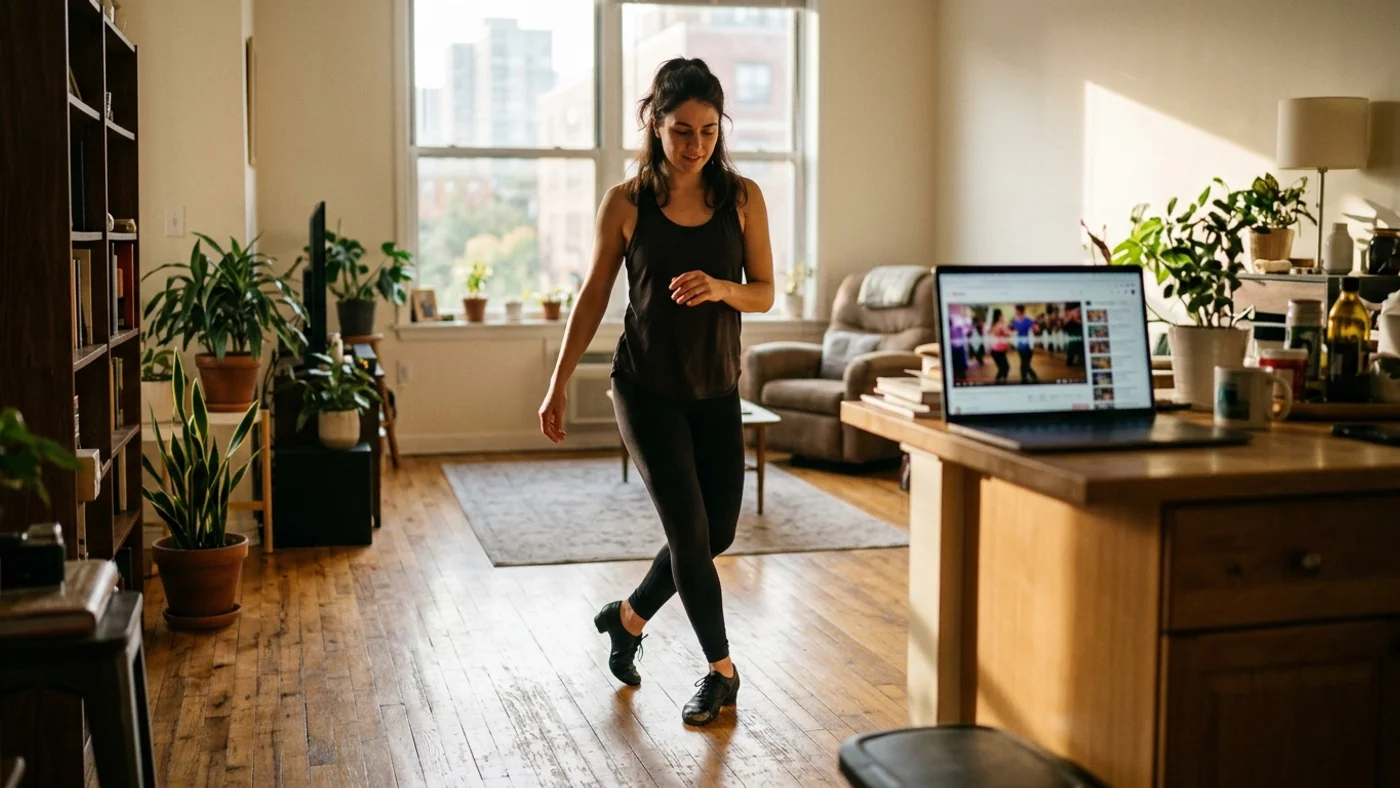
I remember the week I realised how much I could improve without a partner. I had hit one of those plateaus every dancer hits — good enough to survive a social, not good enough to feel like I was actually dancing. My classes were twice a week, my socials were on weekends, and the time in between felt wasted. I could not find a partner for the kind of deep practice I wanted. So I started practicing alone. Thirty minutes a day in my kitchen, footwork drills and musicality exercises, shadow-dancing lead patterns, isolations in front of the oven.
Three months later, my teacher pulled me aside after class and said my footwork had completely changed. He asked who I had been dancing with. The honest answer was “my kitchen floor.” That experience changed how I think about dance practice, and I want to pass the approach on.
This guide is for dancers stuck between lessons, for travellers who cannot find local partners, for beginners who want to accelerate their progress, and for intermediates who have noticed that the gap between them and the best dancers is not partner time — it is solo time. Everything in here you can do in a living room, with a phone speaker and a patch of smooth floor.
What You Can and Cannot Practice Alone
Let’s be honest about what solo work can and cannot give you.
What you can practice alone:
- Basic step and all footwork patterns
- Timing and musicality
- Body isolations and Cuban motion
- Shadow dancing of lead patterns
- Follow-side styling and spins
- Shines (solo footwork sequences)
- Body awareness and posture
- Musical phrase recognition
- Arm styling and frame work
- Listening and counting the music
What you cannot practice alone:
- Actual partner connection
- Reading and responding to real-time signals from another body
- Dancing on a crowded floor
- Negotiating style mismatches
- The social dynamics of asking, declining, and rotating
The takeaway is that solo practice is genuinely transformative for probably 70% of what makes someone a good social dancer. The remaining 30% — connection and adaptability — requires real humans. So pair solo practice with weekly socials and classes. Neither alone is enough. Together, they compound.
If you are brand new to the dance, pair this guide with our salsa dancing for beginners overview to make sure your foundation is solid first.
Setting Up Your Practice Space
You need less than you think.
Floor: smooth, flat, and at least 2 metres by 2 metres of clear space. Wood, laminate, tile, or smooth vinyl all work. Thick carpet is the worst surface because your feet cannot pivot. If you only have carpet, lay down a cheap wood-effect vinyl tile or a small square of dance marley — it is a game-changer.
Shoes: practice in whatever you will dance socially in. If you dance in heels, practice in heels sometimes — your feet need to know the height. Dance sneakers work for most purposes. Do not practice barefoot regularly; your foot mechanics will differ from shod dancing. For shoe recommendations, see our best salsa dancing shoes guide.
Music: a Bluetooth speaker, decent earbuds, or even phone speakers. Volume matters for timing — too quiet and you will lose the beat, too loud and you will lose the subtlety. Build playlists so you are not picking tracks mid-practice.
Mirror: helpful but optional. A full-length mirror on a wall, or a closet-door mirror. If you have none, use your phone as a recording device.
Recording: a phone propped on a stack of books or a cheap tripod. Recording yourself for thirty seconds and watching it back is one of the most efficient practice tools in dance. You see what your partners see.
The Core Solo Practice Menu
Here are the drills I return to constantly. Mix and match into a 20-30 minute session.
Drill 1: The Basic Step, Clean and Slow (5 minutes)
Sounds boring. It is not. The basic step is the foundation of every salsa pattern you will ever do, and most intermediate dancers have unresolved errors in their basic that carry into everything.
Put on a moderate-tempo salsa track around 180-195 BPM. Stand in your open space. Close your eyes for the first pass — feel the weight transfer only. Forward on 1, together on 2, back on 3, pause on 4. Then back on 5, together on 6, forward on 7, pause on 8. The crucial detail: each step is a full weight transfer. Your whole body moves from one foot to the other. Not a tap. Not a partial shift. Full commitment.
Open your eyes and watch your feet in a mirror, or film thirty seconds and check. Things to look for:
- Are you stepping past your standing foot, or only to it? Steps should land in front of or behind the other foot, not next to it.
- Is your weight fully transferring? You should be able to lift the “empty” foot without shifting to do it.
- Are you on the ball of the foot or the heel? Salsa basic lands on the ball first, then the heel settles.
- Is your upper body still? The basic is a lower-body drill. The torso should stay upright and calm.
Do this every session. You will catch things.
Drill 2: Cuban Motion / Hip Work (5 minutes)
Cuban motion is the hip action that makes salsa look like salsa. Beginners often force the hips; good dancers let the hips move naturally from weight transfer. The drill isolates the mechanism.
Stand with feet together. Shift your weight entirely to the right foot. Notice: when you transfer weight onto a straight leg, the hip on that side drops and the other hip rises. Shift back to the left foot. Other hip drops. This is the base mechanism of Cuban motion — weight transfer through straight, then bending knees produces hip movement as a natural consequence.
Now add the step. Step right, knee slightly bent, then straighten. Step left, knee slightly bent, then straighten. The hip movement follows automatically from the knee action. You are not “shaking” your hips — you are letting them move as the legs do their work.
Do this to a salsa track for three minutes. Then add the basic step. Same principle — bend through the step, straighten on the landing, let the hips follow.
For a deeper treatment of body movement fundamentals, see our salsa body movement fundamentals for beginners guide.
Drill 3: Cross-Body Lead (Shadow Practice) (5 minutes)
This is where shadow dancing starts paying off. The cross-body lead is the most common pattern in LA-style salsa and a structural element of the dance.
As a lead: imagine a partner in front of you. Step forward on 1 with the left foot, step back on 2 with the right, turn your body to the right on 3-4, creating space for the imaginary partner to walk past you. On 5-6-7, the follow “crosses” in front of you and you turn to face them again. Shadow the entire pattern without forgetting the hand positions — your right hand “on the back” of your imaginary partner, your left hand holding theirs above.
As a follow: shadow the opposite pattern. Step back on 1, step together on 2, walk across the line on 3-4, step out on 5, step together on 6, back-basic on 7-8. Styling through the hair, the extended arm, the subtle body roll on the crossing step.
Run the pattern ten times, alternating which side you practice. Then add variations — an inside turn for the follow, an outside turn, a hand change.
Drill 4: Spins and Turns (5 minutes)
Spinning alone is one of the most undervalued drills. Most follows never spend dedicated time on their spins and then wonder why they wobble on social floors.
The fundamentals:
- Spot — pick a visual target and keep your eyes on it until the last possible moment, then whip your head around to find it again.
- Spine vertical — not leaned forward, not leaned back. Your head should sit directly above your hips.
- Weight on the ball of one foot, the other foot coming in close.
- Arms stay connected to your centre — do not let them flail out.
Drill: from standing, prep on the right leg (step back with the left), then pivot 360 degrees on the right ball, bringing the left foot in close to the ankle of the standing leg. Land controlled. Repeat ten times on the right, then ten on the left.
Then: double-turn. Same prep, but complete two rotations before landing. The head-spotting is what makes this possible without dizziness. Practice spot-recovery — if you cannot find your target, slow the turn.
Finally: syncopated spin patterns. Turn on 5-6-7 instead of 3-4-5. Turn on count 1. Experiment with when in the music the spin happens. This builds musicality.
Drill 5: Arm Styling (5 minutes)
Arms are most dancers’ weak point, especially for follows. The drill: dance the basic step, hands free, and move your arms through different shapes as you go.
- Arms by your sides
- Arms raised overhead
- Right arm extended to the right, left arm curving across your front
- Both arms curving in waves
- Arms following your hip movement
- Arms floating like you are painting the air around you
Do not “do arm styling” as a performance. Do it as if the music is moving through your arms the same way it moves through your feet. The goal is for your arms to breathe with the music rather than hanging dead or waving distractedly.
Film yourself once a week. Arm styling is one of the most visible upgrades when it clicks.
Drill 6: Shines (Solo Footwork) (5-10 minutes)
Shines are solo footwork sequences within a salsa song, usually danced when partners separate. Learning a handful of shines means you always have something to do when a song breaks down.
Start with simple ones:
- Side-together-side-together
- Syncopated tap-step-tap-step
- The “Suzy Q” — ball-heel swivels in a figure-eight
- Cross-over steps travelling side to side
- Mambo stepping in place
YouTube has countless shine tutorials from reputable teachers. Pick two or three, learn them cleanly, and run them to the music for the shine section of your practice.
Building a Weekly Practice Schedule
Here is a template that has worked for me and for students I have coached.
Monday, Wednesday, Friday (30 min each): technical practice. Basic step drills, Cuban motion, shadow dancing a pattern, arm styling.
Tuesday, Thursday: musicality practice. Pick one song. Dance it start to finish. Pick another and actively listen — identify the clave pattern, the breaks, the vocals, the montuno. Build your ear.
Saturday and Sunday: social dance. Apply everything.
That is roughly three hours of solo practice and five to ten hours of partner time per week. Sustainable, and you will see progress in weeks.
Musicality Practice: The Thing That Changes Everything
Musicality is what separates mechanical dancers from alive dancers, and it is entirely learnable through solo work.
Listening Practice
Pick a salsa track you like. Play it three times.
First pass: listen only. Do not move. Identify the clave. Count the bars. Notice the breaks. Where does the horn section come in? When does the percussion intensify? Where are the musical pauses? This is not dancing — this is reconnaissance.
Second pass: tap the clave with your hand on your thigh. Just the clave. Ignore the rest. This builds your internal metronome for the rhythm that underlies all salsa.
Third pass: dance it, but slow. Basic step only. No patterns. Your whole focus is matching the music’s energy — stepping sharper on strong beats, softer on soft passages, pausing where the music pauses.
Do this with one song a day. Three weeks in, your social dancing will feel different.
Phrase Recognition
Salsa music is structured in phrases. Typically 8 bars, sometimes 16. A good dancer knows when a phrase is ending and when a new one is starting, and shapes their movement to match — building energy through a phrase, hitting an accent on the turnaround, resetting for the next one.
Drill: pick a song, count the bars, mark where each 8-bar phrase ends. Then dance, and try to end your patterns on the phrase endings. Arrive at the beginning of the next phrase with a fresh posture, fresh energy, as if starting over.
This is subtle but transformative work.
Mirror Work vs Recording Yourself
Both have a place. They are not the same.
Mirror: real-time feedback. Good for posture, arm positioning, and spot-checking that you look how you think you look in a given moment.
Recording: seeing the whole motion. You cannot watch yourself in a mirror while dancing because your eyes would have to lock on the mirror and you would lose spotting, connection, and head carriage. Recording catches what mirror use cannot.
The drill: set your phone on a tripod, press record, dance a full 2-3 minute song, stop. Watch it back. You will cringe. Then you will see three specific things to fix next session. That feedback loop is worth more than ten hours of aimless practice.
Working on Connection Alone (Yes, Really)
“But you cannot practice connection alone” — true, but you can practice the things that make connection work.
Frame: stand in front of a wall, both arms extended, palms flat on the wall at shoulder height. Push gently. Notice the resistance. Now dance in place while maintaining that same frame — imaginary partner, real muscular engagement. Your frame should feel firm, engaged, and elastic, not limp or stiff.
Lead-following signals: for leads, practice the specific muscular signals you use — the right-hand-on-back-lead-forward, the left-hand-lift-for-turn, the chest-redirect-for-cross-body. Do them on air, with full commitment, as if a partner is there. Your body learns the precise moment and pressure of each signal.
Follow sensitivity: practice responding to micro-cues. Stand in your frame. Have a friend occasionally and briefly lead you — a small push on the hand, a tiny shift. See how small a signal you can detect. Over time, your sensitivity grows, and you follow lighter leads with ease.
When You Plateau
Every dancer plateaus. The difference is how you respond to it.
Sign of a plateau: you are going to class, going to socials, but feeling the same month after month. Progress has flattened.
Solution options:
- Change your practice. If you have been doing the same drills for months, pick new ones. The body adapts and needs new challenges.
- Work specifically on your weakness. Every dancer has one. Identify yours — weak spins, stiff arms, poor musicality, shaky timing — and give it 10 minutes of targeted work per practice for a month.
- Work with a private teacher for one or two sessions to get an outside eye. Often there is a blind spot you cannot see in the mirror or on your own recordings.
- Travel to dance in a new scene. Different cities have different styles and different standards, and exposure resets your sense of what is possible. See our guides on salsa in New York, Madrid, or Medellin for trip ideas.
Practice While Travelling
A common lament: “I am travelling for work and cannot dance for two weeks.” False problem. You can practice anywhere.
In a hotel room: basic step, Cuban motion drills, arm styling. The space of a bathroom is enough.
In an airport: standing in a gate area, subtle weight transfers and footwork. Nobody will notice. Honestly.
Walking down a street: walk on 1-2-3 (or 2-3-4 for On2) instead of casual timing. You are drilling your rhythmic base without anyone knowing. I have rhythm-walked through half of Europe.
Listening to music on a train or plane: the musicality practice described above requires nothing but your ears.
The dancers who stay sharp while travelling do this kind of thing consistently. It adds up. And it means that when you land back home and go to your next social, you are not two weeks rusty — you are two weeks ahead.
Mental Practice
This sounds strange, but it works. Sports science has shown that mental rehearsal activates many of the same neural pathways as physical practice, though not all. Dancers who visualise their patterns before sleep learn faster.
Before bed, run through a pattern in your mind. Imagine the basic. See the cross-body lead from your point of view as the lead, or as the follow. Feel the music in your head. Imagine where your weight is, where your hands are, what your partner is doing. Ten minutes of this, and the next time you dance the pattern for real, your body has a head start.
Do not replace physical practice with mental practice. Use it as a supplement, especially on days when you cannot physically practice.
The One-Month Challenge
If you want a structured starting point, here is the challenge I give students.
Week 1: 20 minutes, 5 days. Focus on basic step and Cuban motion only. No patterns, no spins, no shines. Record yourself twice.
Week 2: 25 minutes, 5 days. Add cross-body lead shadow work and arm styling. Continue basic and Cuban motion.
Week 3: 30 minutes, 5 days. Add spins (for follows) or leading drills (for leads) and shines. Continue earlier work.
Week 4: 30 minutes, 5 days. Pick one song. Dance it every practice session. Work on musicality and phrase recognition.
At the end of the month, watch your week 1 recordings against your week 4 recordings. You will see the difference. Take that footage to your teacher or a trusted dance friend and ask what you should focus on next.
A Final Note
Social dance has a myth that the only way to improve is partner time — more classes, more socials, more congresses. That is partly true. But the dancers who improve fastest are the ones who do both: social dance consistently, and practice solo between socials.
The solo practice is where you fix the things that partners are too polite to mention. It is where you build the clean basic, the steady spin, the listening ear, the relaxed arms. Those elements then show up on the social floor as a subtle but real upgrade. Partners notice. DJs notice. You notice, because every social feels a little easier than the last.
You do not need a partner to grow. You need twenty minutes, a patch of smooth floor, and a playlist. Start tonight.
For more context on building your foundation, see our salsa for beginners and body movement fundamentals guides. When you are ready to find socials to apply all this, browse salsa events worldwide or check our best beginner-friendly salsa destinations worldwide roundup.