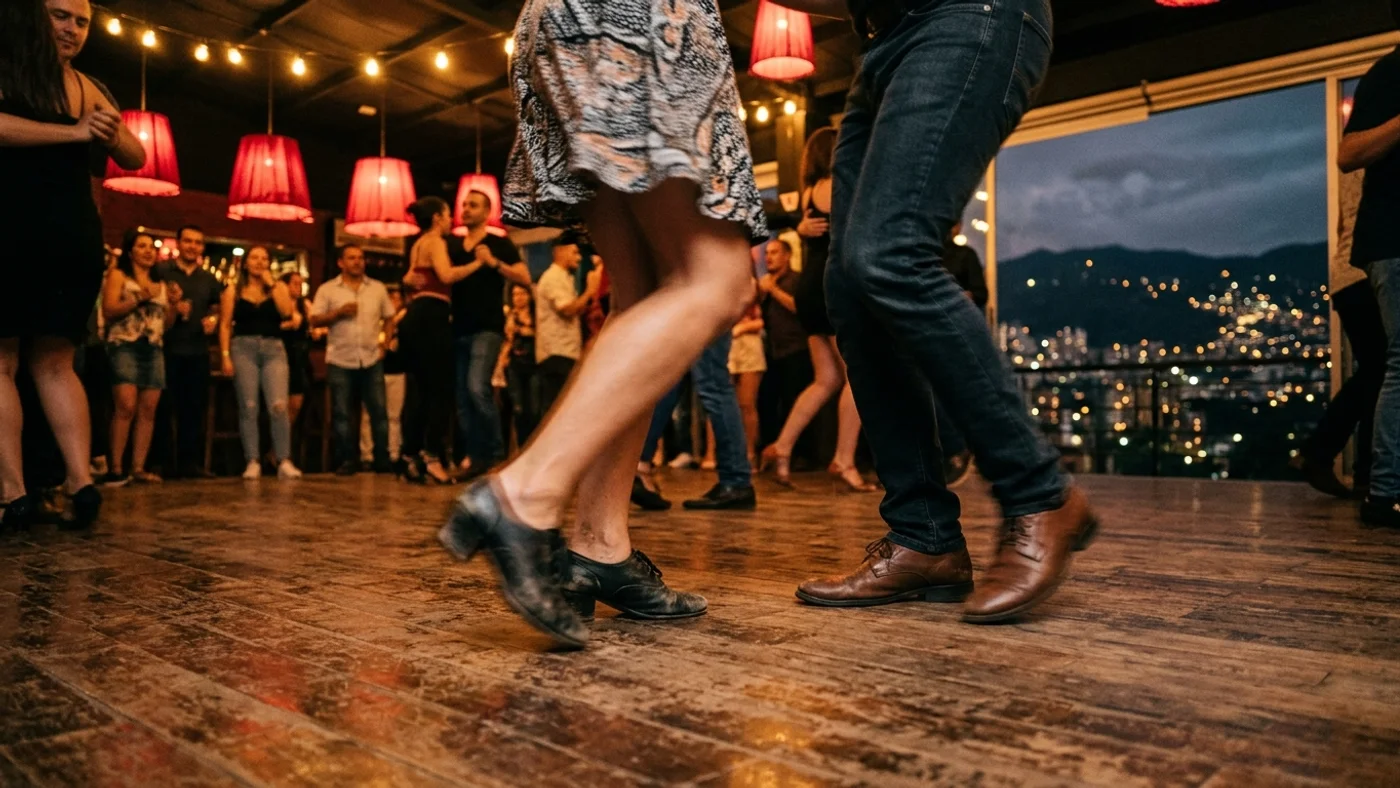
Medellin occupies a complicated place in salsa tourism. It is not Cali — and any dancer who comes to Medellin expecting to find Cali’s world-class salsa factories will be disappointed. Cali is two hours away by plane or ten hours by bus, and it is a different universe: the global capital of cali-style salsa, the home of more professional salsa dancers per capita than anywhere else on Earth, a city where children learn footwork before they learn cursive. Medellin is not that.
What Medellin is, instead, is a city of social dancers. The scene here is smaller, more accessible, and built around neighborhood bars where locals dance for fun several nights a week. It is one of the best introductions to Colombian salsa culture for travelers, especially for dancers who want warmth and musicality without the intimidation factor of a pure-professional scene. This guide covers the real Medellin salsa scene — the neighborhoods, the venues, how to navigate the culture, and how the city fits into a broader Colombian dance trip.
Table of Contents
- What Medellin’s Salsa Scene Is Really Like
- Medellin vs Cali: What’s the Difference?
- The Neighborhoods: Where the Scene Lives
- Iconic Salsa Venues in Medellin
- Understanding Colombian Salsa Style
- What to Expect at a Medellin Salsa Night
- Combining Medellin with Cali and Bogota
- Safety and Practical Tips
- Bachata, Kizomba, and Other Styles in Medellin
- Find Events
- FAQ
What Medellin’s Salsa Scene Is Really Like
The Medellin salsa scene is built around a small number of beloved neighborhood venues that have been running for years, supplemented by a rotating cast of smaller bars, restaurants with weekly salsa nights, and occasional dance-school socials. It is a scene where regulars are recognized by name at the door, where the bartender remembers your drink, and where most dancing happens between locals rather than between tourists and paid instructors.
Compared to European scenes or to North American congress culture, Medellin feels delightfully unstructured. There is no pre-social workshop hour. There is no wristband system. There is no mass rotation protocol. You show up, order an aguardiente or a club colombiana, and either dance or don’t. Nobody will pressure you. But if you can dance — especially if you can dance to cali-style fast music — you will find partners, and you will dance for hours.
The quality of dancers you encounter depends heavily on where you go. A Tuesday night at Son Havana will put you in a room with serious amateurs and genuine local talent. A Saturday at a generic Poblado bar marketed to tourists will put you in a room with people who have taken two classes. Picking venues well is the key to having a great dance trip here.
The scene is also noticeably warmer than most. Medellin has a reputation for friendliness that is not invented by tourism boards — it is real, and it shows up on the dance floor. Eye contact, a smile, and a gestured “vamos a bailar?” will get you a dance from almost anyone. If you come back the next week, they will remember you. This is part of what makes Medellin a repeat-visit city for a lot of traveling dancers. It feels intimate without being small.
If you’re building a broader Latin America dance trip, Medellin pairs naturally with Cali, Bogota, Mexico City, and Havana. Our guide to the best cities for bachata in Latin America covers the bachata side of the same region.
Medellin vs Cali: What’s the Difference?
This question comes up constantly, and the honest answer is that they are different enough that you should not substitute one for the other if you have serious dance ambitions.
Cali is the global capital of salsa. It has hundreds of salsa schools, major international festivals (the Festival Mundial de Salsa and Feria de Cali among them), and a population that treats salsa as a serious art form the way Buenos Aires treats tango. The level of professional dancers is unmatched anywhere in the world — world champions routinely come out of small Cali schools. Social dancing in Cali happens in venues like La Topa Tolondra, MalaMaña, and Zaperoco, all of which appear in our salsa events in Cali listings. The scene is intense, the music is traditional, and the visitor experience can be overwhelming if you are not a confident dancer.
Medellin, by contrast, is a social dancer’s town with a smaller professional scene. The music and style are similar — both cities dance Colombian cali-style — but the intensity and infrastructure are different. Medellin has fewer schools, fewer pure salsa-focused venues, and a more mixed nightlife culture where salsa shares bill with reggaeton, crossover, and other Latin genres.
Which should you visit? If dancing is the sole reason for your trip and you are already an intermediate-or-better dancer, go to Cali — it is the pilgrimage. If you want a more balanced trip that combines great dancing with a welcoming social atmosphere, better food, safer neighborhoods, and a city that is easier to live in for a week, go to Medellin. If you have ten days or more, do both. Fly into Medellin, spend five days, then take the morning flight to Cali for another five. That combination is the gold-standard Colombian salsa trip.
The Neighborhoods: Where the Scene Lives
Medellin is a city of neighborhoods (called “barrios” or “comunas”), and the salsa scene is concentrated in three of them. Knowing which is which will dramatically shape your experience.
El Poblado
El Poblado is the hub for tourists, digital nomads, and traveler-oriented nightlife. It is where most hostels and mid-range hotels are. Parque Lleras is the center of the bar-and-club zone, though Lleras itself is more reggaeton and general party than serious salsa. Poblado has salsa options — usually bar-club hybrids that draw a mixed crowd of locals, Colombian tourists, and visitors — but the quality of dancing is inconsistent.
Best for: first-time visitors, travelers on short trips, anyone who wants to combine salsa with other nightlife.
Worst for: dancers looking for the highest-level local scene or the most authentic atmosphere.
Laureles
Laureles is the neighborhood most Medellin dance locals will tell you to visit. It is a more residential, less touristy part of the city — tree-lined streets, small plazas, neighborhood restaurants, and a dance culture that feels like it belongs to the people who live there rather than to the visitors. Son Havana, the most beloved salsa bar in Medellin, is in Laureles. A Tuesday night at Son Havana with a local crowd is the closest you will get to the “real” Medellin salsa experience without leaving the city.
Best for: serious dancers who want the local scene, repeat visitors, travelers staying more than a week.
Worst for: anyone who wants nightlife to be steps from their hostel.
Envigado
Envigado technically lies outside the Medellin city limits but functions as an extension of it. It is even more local than Laureles — quieter streets, lower prices, and a small but genuine dance scene. El Tibiri, the Friday basement social that has achieved semi-mythical status among traveling dancers, is in Envigado. Getting to Envigado is a short Uber ride from Poblado (maybe 20 to 30 minutes in traffic) or a metro ride plus a short taxi.
Best for: dancers who have already done Poblado and Laureles and want the next level.
Where to Stay
For most first-time visitors, stay in Poblado for safety, convenience, and easy taxis. Plan to take Uber or DiDi to Laureles and Envigado for your dance nights — the rides are cheap (5 to 10 USD) and safer than navigating unfamiliar streets late at night. If you are staying for more than a week and want a more immersive trip, consider an Airbnb in Laureles.
Iconic Salsa Venues in Medellin
A few venues define the Medellin salsa scene, and any serious dance visit should hit at least two of them.
Son Havana
Son Havana is the crown jewel of Medellin salsa — a small, intimate, packed-by-midnight bar in Laureles that has been running salsa nights for years. The Tuesday salsa night has become a pilgrimage stop for traveling dancers, and for good reason: the music selection is impeccable, the crowd is a mix of serious locals and respectful visitors, and the dancing quality is high without being showy. Other nights of the week can vary, but Tuesday is the lock. Arrive early to get a spot near the bar, stay late, and prepare to dance more than you expected.
El Tibiri
El Tibiri is different. It is a basement venue in Envigado, reached by going through a narrow doorway and down a staircase into a low-ceilinged room that fills up with dancers on Friday nights. The music is old-school — son, guaguanco, classic salsa, the music Colombian parents grew up on. The crowd skews local and dedicated. The space is cramped, hot, and absolutely alive when it is full. This is not a place for casual first-timers — dancers come here because they know what they are getting. But if you are ready for it, El Tibiri is one of the most memorable salsa nights you will have in South America.
Other Venues Worth Knowing
Beyond Son Havana and El Tibiri, Medellin has a rotating slate of salsa nights at bars and restaurants across Poblado, Laureles, and Envigado. Specific venues and nights shift more often than in more structured European scenes — new bars open, old ones change their music programming, one-off events pop up through Instagram and WhatsApp. The most reliable way to find current listings is to check salsa events in Medellin before your trip and to ask at your accommodation or at a dance school about the current week’s best nights. Dance schools in Poblado and Laureles are generous about sharing WhatsApp group invites — ask and you will typically be welcomed in.
Understanding Colombian Salsa Style
If you have only danced on1 (LA style) or on2 (New York style), Colombian cali-style will feel alien at first. Here is what you need to know.
Footwork first, patterns second. Colombian salsa is built around ultra-fast footwork — intricate step patterns, quick weight changes, and a relentless rhythmic drive. The upper body stays relatively quiet. Turns and spins happen, but they are not the centerpiece the way they are in LA or NY styles. A great Colombian dancer looks grounded, musical, and impossibly fast from the waist down.
No slot. LA and NY styles are built around a slot — an invisible track that the follow moves along while the lead moves perpendicular to it. Colombian cali-style does not use a slot. Dancers move in a more circular, free-form pattern, often staying close to each other and rotating around a shared center. This means your usual slot-based leading will feel awkward. Adjust by shortening your patterns and keeping your frame compact.
Timing. Colombian dancers do not typically use the on1/on2 vocabulary. They dance on the clave and on the music, but the formal breaking-on-1 or breaking-on-2 framework is not central to the culture. In practice, Colombian dancers break on what most outsiders would call “on1,” but they do not think of it that way. Do not try to explain your timing — just feel it.
Musicality. This is where Colombian dancers will humble you. The musicality runs deep because most local dancers grew up with this music in the house, in the car, at family parties. They hear structure in the song that foreign dancers often miss. The accents, the breaks, the moments to pause — all of it lands naturally for a Colombian dancer in a way that takes most foreigners years of study.
Connection style. Colombian leads and follows dance close, but not in the sensual-bachata way. The connection is playful and technical — leads suggest steps through compact hand movements; follows respond with fast footwork and subtle hips. There is less of a dramatic “sensual” frame than in sensual bachata, and less of the big open patterns of LA on1. Our guide to Cuban salsa vs LA style vs NY style covers the broader style differences in detail.
What to Expect at a Medellin Salsa Night
Timing. Nights start late and peak later. Do not show up at 9pm expecting a busy room. Most venues fill between 11pm and 1am, with the real energy peaking from midnight to 2am. On weekends, many venues stay open until 3am or later.
Dress. Casual but clean. Nice jeans or a sundress, closed-toe shoes, no athletic wear. Medellin dresses better than most Latin American cities on average — put in some effort without going overboard.
Shoes. Bring dance shoes or low-heeled leather-soled shoes. The floors in older salsa bars are often concrete, tile, or worn wood — not great for sneakers, terrible for beat-up heels. If you brought proper dance shoes, this is where they shine. If not, our best salsa dancing shoes roundup has good options, though you can also buy inexpensive leather-soled shoes locally.
Drinks. Aguardiente (Colombia’s anise-forward liquor) is the national pour and the default nightlife drink. Rum and cola is the other classic. Beers (Club Colombia, Aguila, Poker) are cheap. Cocktails are newer and widely available in Poblado. Water is always available — ask for “agua sin gas.”
Paying for drinks. Many venues run on a “consumption minimum” system — you pay a small cover and the cover gets applied to your bar tab. Others have cover plus open bar pricing. Cards are increasingly accepted but cash (Colombian pesos) is still useful — keep 50,000 to 100,000 COP on you for any given night.
Floor etiquette. Standard Latin social norms apply: eye contact plus a gesture to ask, one to two songs per partner, thank your partner when done. A smile and “otra?” (“another?”) asks for a second song. Rejections are rare and usually polite; do not press if someone says no. Broader floor-craft principles are in our dance floor etiquette guide.
Language. Some English is spoken in Poblado tourist venues. In Laureles and Envigado, expect mostly Spanish. Basic phrases go a long way — “quieres bailar?” (do you want to dance?), “gracias, estuvo genial” (thanks, that was great), and “otra cancion?” (another song?) will get you through most situations.
Combining Medellin with Cali and Bogota
Medellin works best as part of a multi-city Colombian dance trip. Here is the standard playbook.
Two cities, one week. Medellin for four days, Cali for three. Fly between them (Viva Air and Avianca both run direct flights, usually 60 to 90 USD). This gives you enough time in Medellin to find the local scene and enough time in Cali for the intensity of the world capital.
Three cities, ten days. Medellin (4) + Cali (4) + Bogota (2). Bogota has its own salsa scene, with more Sensual Bachata than the other two cities, a major international congress calendar, and a range of dedicated venues across neighborhoods like Zona T and Chapinero. Bogota is best as a contrast to the intimacy of the other two — a bigger, more cosmopolitan, more congress-oriented scene. See salsa events in Bogota.
Festival timing. Cali’s Feria de Cali (late December) and the Festival Mundial de Salsa (August) are the two biggest salsa events in South America. Plan a trip around either if you can. Medellin’s own festival calendar is lighter but worth checking on our festival calendar.
Don’t forget the Caribbean coast. If you add Cartagena or Santa Marta to the trip, you get champeta and Caribbean salsa in a different cultural register. It is more vacation, less dance-focused, but the music is rich and the nightlife is alive.
Safety and Practical Tips
Medellin has transformed dramatically over the past twenty years. It is now one of the more visited cities in Latin America, with a robust tourism infrastructure and genuinely welcoming locals. That said, basic traveler awareness still matters.
- Use Uber or DiDi, never street cabs. The apps are cheap and safe. Street-hailed cabs have a history of scams and occasional robberies. This is especially important at night.
- No dar papaya. This is the local expression that roughly translates to “don’t create opportunity.” Don’t flash phones, don’t wear visible jewelry, don’t leave bags unattended at bars, don’t pull out large amounts of cash in public.
- Stay in Poblado, Laureles, or Envigado. These neighborhoods are safe at night with normal precautions. Avoid El Centro after dark unless you have specific plans and know the area.
- Carry a copy of your passport, not the original. Police sometimes ask for ID. A photocopy plus your Colombian cedula or entry stamp photo on your phone is enough.
- Altitude is fine. Medellin is at about 1,500 meters — noticeable on a hike but irrelevant for dancing. Bogota is higher (2,600 meters) and can affect stamina.
- Money. Colombian pesos are weak enough that you will be handling 100,000-peso bills routinely (about 25 USD). ATMs are easy to find. Use one inside a bank or major chain rather than street ATMs. Count your cash before you leave the ATM.
- Spanish. Learn more than “hola” and “gracias.” Medellin is less English-friendly than Mexico City or Buenos Aires. Basic Spanish dramatically improves your trip.
- Weather. Medellin is famously the “City of Eternal Spring” — temperatures run 18 to 28 degrees Celsius year round. Pack layers; it can be cool at night. Rain is possible in any month.
Bachata, Kizomba, and Other Styles in Medellin
Salsa is the dominant style in Medellin, but bachata has a growing scene — mostly sensual bachata, influenced by congress culture imported from Europe. You will find bachata mixed into many salsa nights rather than as standalone events, with occasional dedicated bachata socials on weekends. For style context, our bachata sensual vs traditional vs modern guide explains what you will encounter. See current listings on bachata events in Medellin.
Kizomba and zouk are small but present. A few dedicated dance schools run weekly kizomba practicas, and the festival scene occasionally brings in international kizomba instructors. If you dance kizomba or want to try it, our kizomba for beginners guide covers what to expect at your first social.
Cuban salsa (casino) has a small but real following, often centered on specific dance schools rather than dedicated venues. If you dance casino, check salsa events in Medellin for rueda-focused events.
Find Events
Our salsa events in Medellin page lists the current schedule and is updated as venues confirm their weekly programming. For travelers doing a broader Colombian trip, see also salsa events in Cali and salsa events in Bogota. Use the interactive map to see exactly where venues are relative to where you are staying.
If this is your first dance trip to Latin America, our guide on how to find social dance events while traveling is worth a read. And for the broader Latin American context, best cities for bachata in Latin America covers the regional scene for bachata dancers.
FAQ
Is Medellin good for salsa dancing?
Yes, but with context. Medellin is not Cali — Cali is the world salsa capital and the center of Colombian cali-style salsa. Medellin’s scene is smaller but more accessible for travelers, with a well-developed mix of neighborhood salsa bars, traveler-friendly clubs in El Poblado, and more local venues in Laureles and Envigado. The dancing quality is high and the musicality runs deep. It is one of the best introductions to Colombian salsa culture for visiting dancers.
What style of salsa is danced in Medellin?
Primarily Colombian cali-style salsa, characterized by ultra-fast footwork, a grounded center, minimal upper-body movement, and a bouncy, joyful feel. This is very different from on1 (LA style) or on2 (New York style) — Colombian dancers do not typically follow the same slot-based patterns that define global salsa culture. Expect to adjust your frame and slow down your leads. Medellin dancers are used to dancing with visitors and will meet you halfway if you show respect for their style. Our Cuban salsa vs LA style vs NY style guide goes deeper into style differences.
Where should I stay in Medellin as a salsa dancer?
El Poblado is the easy choice for first-time travelers — it is safe, walkable, full of hostels and Airbnbs, and has the most traveler-friendly salsa venues. Laureles is a better choice if you want a more local scene, with quieter streets and a more authentic neighborhood feel. Envigado is even more local and a short Uber or metro ride from the main action. Avoid staying in the centro at night unless you have specific plans.
Is Medellin safer than it used to be?
Yes, considerably, but still requires basic traveler awareness. Stick to El Poblado, Laureles, and Envigado at night. Use Uber or DiDi — avoid street-hailed cabs. Do not wear obvious jewelry or flash your phone. Do not walk alone in unfamiliar neighborhoods after dark. Follow the standard “no dar papaya” rule (do not give opportunity) and you will be fine. The dance scene itself is welcoming and safe — the risks are the same as any Latin American city.
Which night is best for salsa in Medellin?
Tuesday is the classic salsa night at Son Havana, one of the city’s most loved salsa bars. Fridays at El Tibiri are an institution for dedicated Colombian-style dancers. Weekends generally bring the biggest crowds across multiple venues. That said, Medellin has salsa somewhere every night of the week — the scene is consistent enough that you rarely have a dead night.