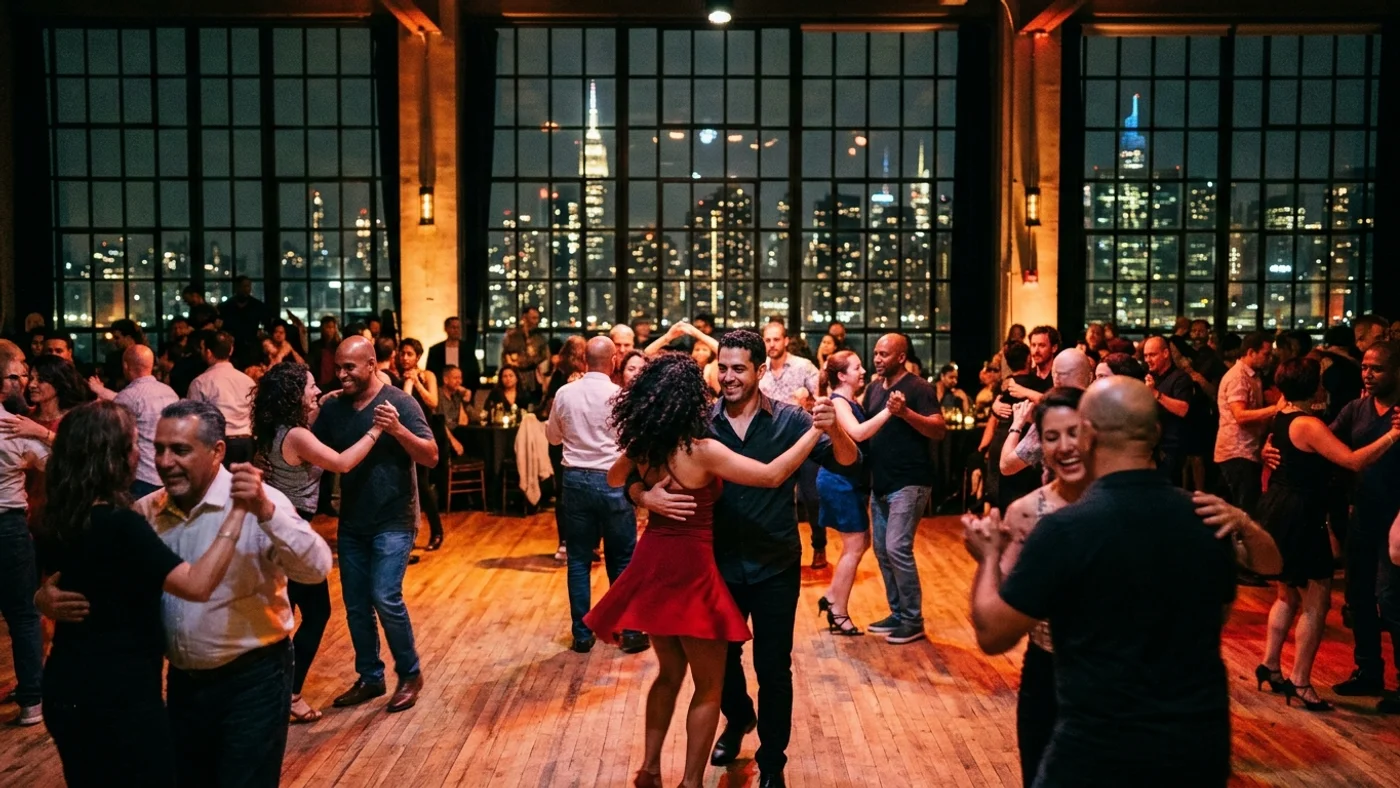
North America is a continent of very different salsa scenes. New York gave the dance its modern form through the Palladium era and the 1970s salsa boom. Miami preserves the Cuban casino tradition through direct family lineage from the pre-1959 island. LA built the clean studio-driven On1 style that most of the world now dances. Mexico City runs one of the largest Spanish-language scenes outside Latin America. Toronto and Montreal punch above their weight for cities their size.
This guide ranks the seven best North American cities for salsa in 2026 based on scene depth, style breadth, and how rewarding each is for a visiting dancer. Honest framing up front: there is no single “best” city — the right destination depends on which style you dance and what kind of scene you want to walk into. A hardcore On2 dancer and a casino rueda dancer will make very different recommendations from the same list. We have tried to be fair to each tradition rather than rank them against each other.
If you are new to the stylistic divisions, our guide to Cuban salsa vs LA-style vs NY-style explains what you are walking into before you book a flight.
Table of Contents
- New York City
- Miami, Florida
- Los Angeles, California
- Mexico City, Mexico
- Chicago, Illinois
- Toronto, Ontario
- Montreal, Quebec
- Honorable Mentions
- Planning a North American Salsa Trip
- FAQ
New York City
New York is the birthplace of modern salsa and remains the most serious city in the world to dance it. The Palladium Ballroom in the 1950s hosted Tito Puente, Machito, and Tito Rodríguez playing to a mixed Black, Puerto Rican, and Jewish audience, and the dance that emerged there became the foundation for On2 mambo. Everything that happened afterward — Eddie Torres codifying the style, the 1970s Fania salsa boom, the congress circuit — traces back to New York.
Style mix: On2 New York-style mambo is the city’s defining style and has no real competition globally. LA-style On1 is dominant among younger social dancers. Cuban casino rueda has a small, devoted following concentrated around specific weekly nights. Bachata has grown aggressively in the past decade and now shares most social floors, though it is still secondary to salsa in most dedicated venues.
Best nights and neighborhoods: The core scene spreads across Manhattan and the outer boroughs. Piel Canela and Dance with Kyoko anchor the studio culture. Wednesday nights at dedicated On2 socials across Midtown and the Financial District draw the hardcore community. Weekends rotate across larger venues — the New York Salsa Congress circuit has trained a generation of dancers who expect a certain level of musicality and lead clarity. Queens and the Bronx have culturally rooted Puerto Rican and Dominican scenes that are smaller in number but deeper in tradition. Across the Hudson, Union City and West New York, New Jersey, have Cuban and Puerto Rican social dancing that is continuous with the New York scene.
What makes it special: The skill ceiling. New York is the city where you can dance with someone who has been on the floor for forty years, watch them lead a complete beginner through a seamless dance, and then see them compete at a world level the next weekend. The density of elite dancers concentrates here because the scene demands it — mediocre technique gets exposed quickly, and the social pressure to improve is real.
Practical notes: The scene is expensive. Expect $20 to $40 at the door for dedicated salsa nights, and most major studios charge $20+ for drop-in classes. The subway runs 24/7, which is uniquely helpful for late-finish dancers. Winter is cold but nothing closes — serious dancers show up in coats and change clothes at the venue. The New York International Salsa Congress over Labor Day weekend is the flagship annual event, and the New York SBKZ Congress 2027 in late January provides a winter anchor.
Find all salsa events in New York and read our city guide to salsa dancing in New York.
Miami, Florida
Miami is the Cuban capital of North America and has the most culturally continuous salsa scene on the continent. The Cuban community that arrived after 1959 brought casino and rueda with them intact, and that tradition has been transmitted unbroken through three generations. If you want to dance salsa the way it is danced in Havana, Miami is the closest you can get without a US-Cuba flight.
Style mix: Cuban casino is dominant in a way that is unique to Miami — this is the only major North American city where Cuban-style salsa is the default rather than a niche. Rueda de casino (the circular group dance with called figures) is genuinely social here, not a performance specialty. LA-style On1 has a strong following at the studios that serve younger and international dancers. On2 has a smaller presence than you would expect given Miami’s proximity to the rest of the Americas.
Best nights and neighborhoods: The scene spreads across Little Havana, Wynwood, Brickell, and the Kendall suburbs. Ball & Chain and other Calle Ocho venues host live bands multiple nights a week with social dancing on the floor between sets. Studio-run socials at Salsa Racing Academy and others anchor the more training-focused community. Saturday nights at Latin-music clubs in Brickell and South Beach cater to the mixed tourist-local crowd. Weekly casino rueda socials run in Coral Gables and Kendall.
What makes it special: Live music culture. Miami is one of the few North American cities where you can dance salsa to a live band on a Tuesday, not just at festival weekends. The interplay between dancers and musicians at venues like Ball & Chain recreates something that in most cities only exists in grainy Fania All Stars footage. For a dancer who has only ever danced to DJs, a first night in Miami dancing to a live timba band is a revelation.
Practical notes: The scene runs later than New York — Cuban cultural norms shift the peak to 11 PM to 2 AM. Many venues do not take reservations; show up early for popular nights. Dress codes are enforced at upscale venues — Miami is a dress-up city. Summer humidity is brutal but most salsa venues are well air-conditioned. Note: our salsa events in Miami listings are currently thin and weighted toward the English-speaking dance-studio scene — the deepest Cuban dance culture here is advertised primarily in Spanish and spread by word of mouth rather than event platforms.
Los Angeles, California
Los Angeles built LA-style On1 salsa. The clean, linear, performance-ready style that now dominates most of the world’s studio scenes was codified in LA in the 1990s and 2000s by Albert Torres, Francisco Vazquez, and the Vazquez brothers. That lineage still defines what dancing looks like on most LA floors today — long lines, clean slot work, heavy emphasis on styling and choreography.
Style mix: LA-style On1 is dominant and is danced here at a consistently high technical level. Cuban casino has a small community concentrated around specific weekly socials in West LA and the Valley. On2 exists but is a minority style — most Angelenos who dance On2 learned it from visiting New Yorkers. Bachata has grown into a near-equal partner with salsa at most socials, and LA sensual bachata has a distinct performance-driven aesthetic.
Best nights and neighborhoods: The scene spreads across the whole basin. Downtown LA, West LA, Hollywood, and the San Fernando Valley each have their own weekly rotations. Steven’s Steakhouse in Commerce runs a legendary Sunday salsa social that has operated continuously for decades — ask any LA dancer over 40 and they have stories about it. Granada in Alhambra is another institution. Mayan Theater events, Conga Room nights, and studio-hosted socials at Rumbankete and Oxygen Studios fill out the weekly calendar. Weekend socials at larger venues bring 200+ dancers regularly.
What makes it special: Production value. LA salsa has been professionalized in a way that few other scenes have — floors are consistently excellent, DJs are experienced, and the level of styling and shining is on average higher than in most other cities. If you want to dance in a room where everyone has clearly trained and everyone cares about execution, LA delivers.
Practical notes: Distances are real. Do not plan to dance in Downtown LA on a Friday and Santa Monica on a Saturday without accepting long drives. Parking is a persistent issue — budget time and cash. Entry fees are $15 to $30 for most socials, with studio-hosted events on the higher end. The Reno Latin Dance Fest 2027 in January is a close driveable winter anchor for Southern California dancers.
Find all salsa events in Los Angeles.
Mexico City, Mexico
Mexico City runs one of the largest Spanish-language salsa scenes in North America and the largest salsa community on the continent outside the United States. The scene is distinctive — culturally rooted, musically sophisticated, and deeply connected to both Cuban and Colombian influences — and it is genuinely affordable in a way that no US city is anymore.
Style mix: Cuban casino has a strong following thanks to historical Cuban immigration and active cultural exchange. Colombian Cali-style salsa has a visible community, particularly around nights that play salsa dura and salsa romántica. LA-style On1 dominates the studio scene and younger social events. On2 is present but minor. The Mexican approach to salsa emphasizes musicality and flirtation over pattern complexity.
Best nights and neighborhoods: The scene centers on the Roma, Condesa, and Zona Rosa neighborhoods, with additional weekly events across Polanco and the Centro Histórico. Mama Rumba in Roma Norte is the long-running institution — live bands, full dance floor, a decades-long history. Salón Los Ángeles in the Guerrero neighborhood has been operating since 1937 and is the oldest continuously running dance hall in Latin America; it hosts salsa and danzón nights with a cross-generational crowd that is worth the visit for the atmosphere alone. Weekly studio socials at schools across the city feed the community with newer dancers.
What makes it special: Cultural authenticity at accessible prices. A night of dancing with live music at Mama Rumba or Salón Los Ángeles costs a fraction of what a comparable night in New York would, and the cultural texture — the way Mexican dancers interpret Cuban music, the easy flow between live bands and recorded sets, the absence of studio-competition energy — creates an experience that US scenes cannot replicate.
Practical notes: Spanish is strongly preferred at most venues, though English is increasingly spoken in the Condesa and Roma expat-adjacent nights. Entry fees are 100 to 300 MXN (roughly $5 to $15 USD) for most socials. Altitude (2,240 meters) affects stamina — first-night visitors often burn out fast, build in recovery time. Live band nights are the peak experience; check schedules in advance.
Find all salsa events in Mexico City and read our city guide to salsa dancing in Mexico City.
Chicago, Illinois
Chicago has a smaller salsa scene than the three major coastal cities but compensates with a tight, committed community and a distinctive Midwest sensibility. The scene is heavily Puerto Rican in its roots, has a strong Colombian contingent, and runs at a consistently high technical level thanks to a few long-established studios that have trained local dancers seriously for decades.
Style mix: On2 New York-style has a visible following, supported by close connections to the New York scene and regular visits from top instructors. LA-style On1 is the numerical majority. Colombian-style salsa has a dedicated community centered around Latin-music nights that prioritize salsa dura and salsa cubana over studio styles. Cuban casino has a small but active rueda community.
Best nights and neighborhoods: The scene spreads across the Loop, River North, Logan Square, and the Northwest side. Studios like Latin Street Dancing and Chicago Dance anchor the community. Weekly socials rotate through dedicated venues and hotel ballrooms. The large Puerto Rican and Colombian populations on the Northwest side support culturally rooted Latin-music nights that are distinct from the studio-driven weekly socials. Summer brings outdoor events in Humboldt Park and festivals tied to the Puerto Rican community.
What makes it special: The Chicago community is famously welcoming to visiting dancers. The scene is small enough that regulars recognize newcomers fast, and the Midwestern social norms — direct but friendly — translate well to the dance floor. Technical levels at the top end are high, partly because Chicago dancers regularly travel to congresses in New York and Florida and bring that training home.
Practical notes: Winter is serious. December through March, outdoor events are nonexistent and indoor dancing continues but with lower attendance on brutal-cold nights. Summer is the scene’s peak. Entry fees are $15 to $25 for most socials. Public transit (CTA) is reliable but does not run as late as NYC’s — plan accordingly. Note: we currently do not have active event listings for Chicago in our database — check local studios directly until our coverage improves.
Toronto, Ontario
Toronto has one of the most internationally diverse salsa scenes on the continent. The city’s immigration patterns have brought dancers from Cuba, Colombia, Venezuela, Puerto Rico, Ecuador, and the broader Caribbean, and the result is a scene where multiple styles coexist naturally rather than competing for dominance.
Style mix: LA-style On1 dominates the studio scene. Cuban casino has a strong, active community with dedicated rueda nights. Colombian Cali-style has a visible following. On2 has a smaller presence but reliable weekly nights. Bachata has grown significantly, and Toronto runs one of the stronger Canadian bachata communities.
Best nights and neighborhoods: The scene spreads across downtown, Kensington Market, and the suburban studios in Mississauga and Scarborough. Lula Lounge on Dundas West is the long-running institution — live Latin bands multiple nights a week with social dancing. Salsa on St. Clair each summer shuts down a stretch of the street for a weekend of outdoor Latin dancing and is one of the best urban salsa festivals in the country. Studio socials run weekly at venues across the core.
What makes it special: The cultural diversity of the community. A single social in Toronto might have a Cuban couple leading rueda in one corner, a Colombian salsa dura crowd in another, and an On2 line dance against the far wall. That pluralism is rare — most North American cities are dominated by one or two styles — and it makes Toronto an unusually good destination for dancers who want exposure to multiple traditions in one trip.
Practical notes: Winters are long and cold. Dress in layers, budget for taxis on harsh nights, and accept that outdoor events are summer-only. Entry fees are 15 to 25 CAD for most socials. The TTC public transit runs late but gaps in service make cabs or rideshares a safer bet after 1 AM.
Find all salsa events in Toronto.
Montreal, Quebec
Montreal has a distinctive French-Caribbean-inflected salsa scene that does not quite resemble any other North American city. The large Haitian community, French-Canadian culture, and significant Colombian and Dominican populations combine to produce a scene with its own flavor — more European than the rest of North America in atmosphere, but with the Caribbean cultural texture that most European cities lack.
Style mix: LA-style On1 is numerically dominant. Cuban casino has an active following. Bachata shares the floor at most socials and has a particularly strong presence thanks to Dominican immigration. Kizomba has a visible community that benefits from cross-pollination with the large Haitian-Canadian cultural scene.
Best nights and neighborhoods: The scene centers on the Plateau, Mile End, and downtown. Cabaret du Mile End, Balattou, and various studio socials anchor the weekly calendar. Summer brings outdoor events tied to the jazz festival and the Francofolies circuit — salsa stages pop up alongside mainstream music festivals, pulling large crowds. Winter socials run at indoor venues and studios but at reduced volume.
What makes it special: The bilingual, European-feeling urbanism creates a different dancing environment than elsewhere in North America. Venues are smaller, nights run later, and the social vibe is closer to what you find in Lyon or Brussels than what you find in Toronto. French-language events add a cultural dimension that English-only dancers sometimes miss but can still enjoy.
Practical notes: Winter is hard. Most socials continue through winter but attendance dips in January and February. Summer is the peak — the entire city comes alive, outdoor events are everywhere, and international visitors treat Montreal as a dance-trip destination. Entry fees are 10 to 20 CAD, lower than Toronto. Basic French is appreciated but most venues operate comfortably in English.
Find all salsa events in Montreal.
Honorable Mentions
Vancouver, British Columbia
Vancouver has a small but dedicated salsa scene with a strong Latino community and good studio culture. The scene is heavily LA-style On1, with a smaller Cuban casino contingent and a growing bachata community. Weekly socials run year-round at venues across downtown and Main Street. Less deep than Toronto but genuinely welcoming to visitors, and the summer outdoor events along the waterfront are spectacular.
Washington, DC
The capital has an active salsa community driven by its diverse immigrant population — Salvadoran, Peruvian, Colombian, and Caribbean communities all contribute. The scene skews On2 and casino, and weekly socials run at venues in Columbia Heights, Adams Morgan, and the Virginia suburbs. Smaller than New York but technically solid and friendly to visitors.
Houston and San Antonio, Texas
Texas has an underrated salsa infrastructure. Houston’s scene is large, Latino-majority, and culturally rooted — less performance-driven than LA, more socially focused. San Antonio’s scene is smaller but benefits from the city’s deep Mexican-American culture. Both cities run weekly socials and occasional large festivals.
Havana, Cuba
Geographically Caribbean but often grouped with North America for travel purposes. If you can get a travel visa, Havana is the cultural source — casino and rueda in their living form. Casa de la Música Havana, 1830 Club, and Salón Rosado de la Tropical host weekly events. Cuban listings online are thin because most Cuban dance culture is not advertised on international event platforms. For comparison with other Latin American scenes, see our guide to the best cities for bachata in Latin America.
Guadalajara and Monterrey, Mexico
Mexico City gets the attention but Guadalajara and Monterrey both have active salsa scenes with their own regional flavors. Guadalajara has a strong Colombian-influenced scene and hosts occasional festivals. Monterrey’s scene is smaller but benefits from cross-border exchange with Texas.
Orlando, Florida
Orlando has become a significant salsa destination thanks to the large Puerto Rican community that relocated after Hurricane Maria and the consistent tourist economy. The scene is growing fast and hosts multiple annual festivals. Less culturally deep than Miami but more beginner-friendly and less expensive.
Planning a North American Salsa Trip
Pick a style and match the city. If you dance On2, go to New York. If you want Cuban casino, go to Miami or Havana. If you want clean LA-style On1 at high technical level, go to Los Angeles. If you want Spanish-language cultural richness at accessible prices, go to Mexico City. Trying to hit all four in one trip dilutes the experience.
Stack a congress with local scene time. Congresses concentrate elite dancers and international energy; local weekly socials show you what the community actually dances. A three-to-five day congress paired with four or five nights of regular weeklies in the same city gives you a complete picture.
Respect the skill ceiling. New York, LA, and Miami are all cities where you will share the floor with dancers who have trained for decades. A beginner who walks into a Wednesday On2 social at a serious NYC venue without any training will not have a good time. Take a class, warm up at a studio social, and build your way up to the hardcore nights.
Build in rest days. The dance week in any of these cities can run four to seven nights if you let it. Without rest days you burn out by day three and end up dancing tired for the rest of the trip. Better to dance fewer nights well than all nights poorly.
Pack proper shoes. North American dance floors vary wildly — polished wood at high-end studios, concrete at some Miami venues, carpet at hotel-ballroom congresses. Suede soles handle most surfaces; a dance brush in your bag matters more than most people realize. Our guide to salsa dance shoes covers the essentials.
Budget by city tier. New York and LA are expensive ($40 to $80 for a full night with drinks). Miami and Chicago are mid-tier. Toronto and Montreal sit below Miami. Mexico City is the value option — a full dance night costs less than a subway round-trip in New York. Stack a high-cost city with a lower-cost one to manage the overall trip budget.
Plan around peak seasons. September through early November and March through May are the best all-around windows. Summer is great in northern cities (Toronto, Montreal, Chicago) and brutal in Miami and Mexico City. Winter works for Miami, LA, and Mexico City; avoid Toronto, Montreal, Chicago, and New York in deep winter unless you are committed to indoor-only dancing.
Check current schedules. Venues close, weekly nights move, and organizers pivot — especially for smaller weekly socials. Verify everything on our salsa page before booking. Browse the full festival calendar for the major anchor events and our guide to the best salsa festivals 2026 for a season-by-season overview.
FAQ
Which North American city has the best salsa scene?
New York. It is the birthplace of On2 mambo, has the deepest concentration of elite instructors, and runs social dancing seven nights a week across multiple dedicated venues. Miami is the strongest challenger thanks to its Cuban heritage and casino rueda tradition. Los Angeles leads on LA-style On1 and has the highest production values. If you only have one salsa trip in North America, and you are serious about the dance, start with New York.
Where can I find authentic Cuban salsa in North America?
Miami is the undisputed Cuban capital of the continent — the post-1959 diaspora built a casino rueda community that has never stopped, and three generations of Miami Cubans have kept the tradition continuous. For a more working-class Cuban scene, Union City and West New York (New Jersey) across the Hudson from Manhattan have a dense Cuban-American dance culture. Mexico City and Toronto also have active Cuban salsa communities. For the root source, Havana itself is the ultimate destination if you can travel there.
Is the New York salsa scene beginner-friendly?
Mostly yes, but with conditions. Studios like Piel Canela, Dance with Kyoko, and the Stepping Out system run tiered beginner classes that feed into supervised socials, and those are genuinely welcoming. Walking cold into a Wednesday On2 social at a hardcore venue without any training will be humbling — NYC has the highest concentration of elite dancers in the world and the floor reflects that. Take a class first, then build into the social nights. Our salsa dancing for beginners guide covers the basics.
Should I go to LA or New York for salsa?
Depends on your style and your tolerance for intensity. LA for clean On1 with strong styling, a performance culture, more beginner-friendly social spaces, and a warmer climate. New York for On2 mambo, Puerto Rican musicality, and a harder-edged dance culture where technique is non-negotiable. If you only have one trip and you want to experience salsa at its most serious, pick New York. If you want to train cleanly and enjoy consistent high-production socials, pick LA.
When is the best time of year for a salsa trip to North America?
March to May and September to November for most cities. Miami works year-round thanks to the warm climate. The New York congress circuit peaks around the New York International Salsa Congress over Labor Day weekend. Avoid Toronto, Montreal, and Chicago in deep winter (January to early March) unless you are committed to indoor-only dancing. For a continent-wide comparison, see our guide to the best salsa cities in Asia and the best cities for salsa in Europe.
Find Salsa Events in North America
Browse all salsa events to find socials in your destination city. Our complete festival calendar lists every verified event across the continent. For the bachata companion to this guide, see our best bachata cities in North America. Traveling dancers should also read how to find social dance events while traveling and review dance floor etiquette before walking into an unfamiliar scene. For city-specific detail, our guides to salsa dancing in New York, Mexico City, and Medellín cover individual scenes in depth.